The 5 Features Every Legal Document Automation MVP Actually Needs
Document automation can cut drafting time from 3 hours to 15 minutes. But most MVPs fail by building too much too soon. Here are the 5 features that actually matter.
January 17, 2026 10 min read
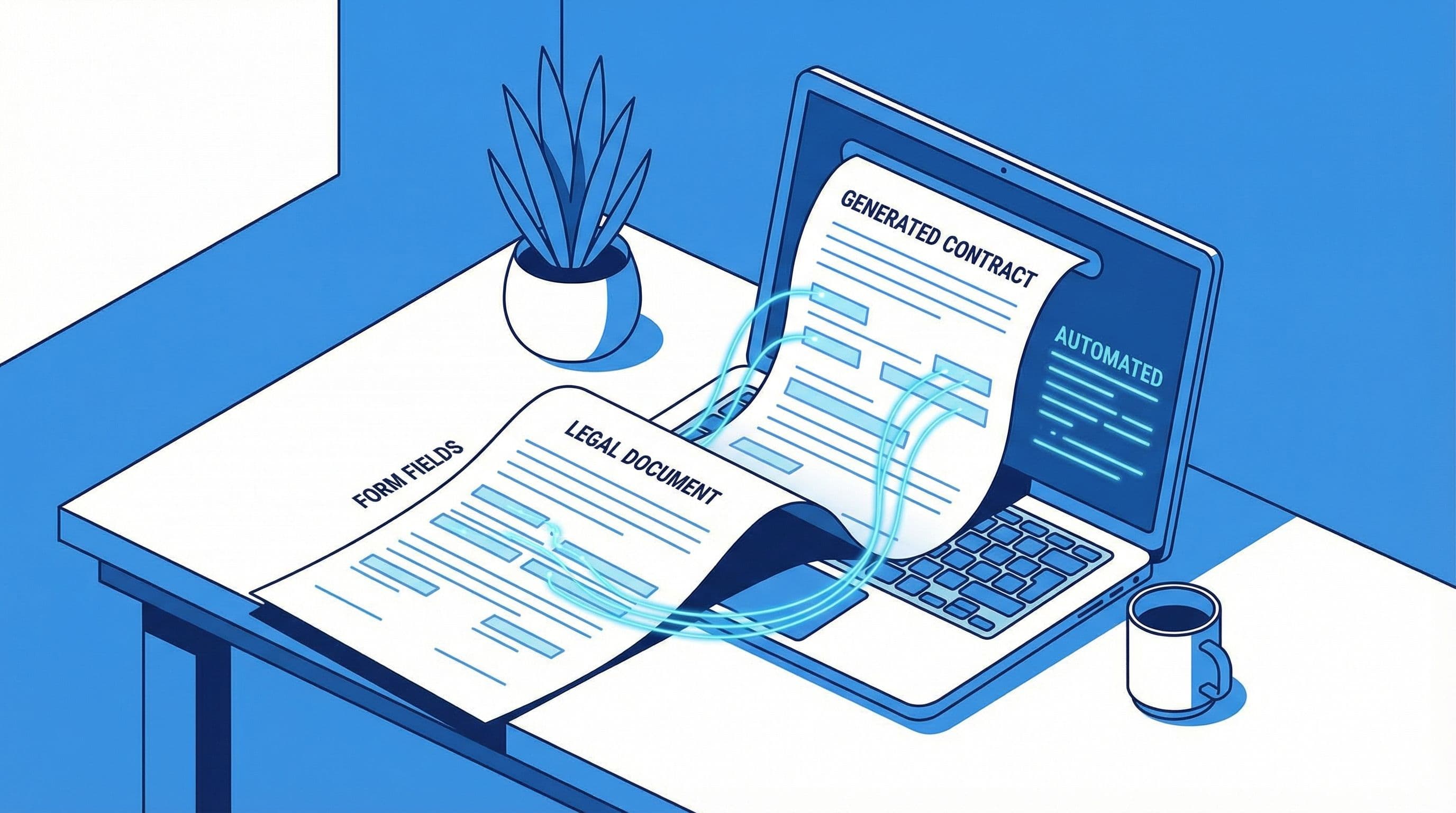
A law firm test showed that automating document creation cut drafting time from about 3 hours to 15 minutes on average. That's an 80% reduction in creation time for standard contracts.
The ROI is obvious. Yet most legal document automation MVPs fail—not because the market doesn't exist, but because founders build too much too soon.
We've seen this pattern repeatedly: 15 logic branches, nested approval workflows, integrations with six enterprise systems, AI-powered clause suggestions. All before a single paying customer.
The document automation market is real—projected to grow from $2 billion to $6 billion by 2033. But winning requires restraint. Here are the five features that actually matter for your MVP, and the extensive list of what you should defer.
The Over-Scoping Trap
"Too much complexity, too soon: Over-complicating flows with 15 logic branches or nested approvals will slow you down and confuse stakeholders from the beginning."
This advice from Juro captures the core failure mode. The teams that ship successful document automation MVPs share one trait: they resist the urge to build everything.
You don't need to automate everything. The repetitive processes that slow you down most and fulfil you the least are a good place to start. Start with ONE template, perfect it, then expand.
Each branch in your logic tree adds complexity. Each integration creates maintenance burden. Each "nice-to-have" feature delays your time to market and your ability to validate whether anyone actually wants what you're building.
Feature 1: Template Import and Creation
Every document automation tool starts here. If you can't turn existing documents into automated templates, nothing else matters.
What to build
Import existing documents: Law firms have thousands of existing Word documents and PDFs. Your MVP needs to accept these formats and convert them into templates without requiring a complete rewrite.
Stop planning and start building. We turn your idea into a production-ready product in 6-8 weeks.
Variable field marking: Users need to identify which parts of a document should be dynamic—party names, dates, jurisdiction, compensation terms. This can be as simple as wrapping text in double brackets: {{client_name}}.
Word-based interface: Lawyers live in Microsoft Word. The most successful platforms (HotDocs, Knackly, Gavel) offer Word add-ins or browser interfaces that feel familiar. Don't force users to learn a new paradigm.
Practice-area starting templates: Accelerate adoption by including templates for common documents: NDAs, engagement letters, basic contracts. These serve as both examples and immediately useful tools.
What to defer
AI-powered template generation
Complex template versioning systems
Template marketplace or sharing features
Migration tools from competitor platforms
Technical implementation
The simplest approach: store templates as JSON with content blocks and variable markers. Use a library like docxtemplater for Node.js or python-docx for Python to handle the Word document manipulation.
Feature 2: Conditional Logic Engine
This is what separates document automation from mail merge. Legal documents have clauses that appear or disappear based on circumstances. Governing law varies by jurisdiction. Payment terms differ by client type. Indemnification language changes for enterprise vs. SMB deals.
What to build
IF/THEN statements: The most basic conditional—if a condition is true, include this clause. If false, exclude it or substitute alternative language.
Boolean combinations: Support AND/OR logic for complex scenarios. "If the deal is over $100,000 AND the client is in healthcare, include additional compliance language."
Variable-driven sections: Entire sections that appear or disappear based on a single variable selection. Choose "subscription agreement" and see subscription-specific clauses; choose "one-time purchase" and see different terms.
What to defer
Nested logic beyond 2-3 levels
AI-powered clause suggestions
Risk scoring for clause combinations
Complex mathematical calculations
Multi-document dependencies
The complexity trap
Every founder thinks their logic is simple. Then they try to handle every edge case. One Juro recommendation stuck with us: "Start with the basics and work upwards from there."
Focus on what truly varies in 80% of your documents: governing law, party names, key commercial terms. Don't code for every theoretical scenario. You can add complexity after you've validated the core value proposition.
Feature 3: Form-Based Data Collection
Somewhere, someone needs to provide the data that populates your templates. This is where questionnaires come in—guided interfaces that collect information and feed it into document generation.
What to build
Dynamic questionnaires: Questions that appear based on previous answers. Selected "California" as jurisdiction? Show California-specific questions. Selected "subscription" as deal type? Ask about billing frequency.
Client-facing portal: Allow clients or third parties to complete questionnaires without needing accounts or training. Gavel does this well—clients access branded web forms, complete questionnaires, and the attorney gets populated documents.
Variable field mapping: Clear connection between form fields and template variables. What the user enters in the "Client Name" field should populate every {{client_name}} variable across all generated documents.
Basic validation: Required fields, format validation (dates, emails, phone numbers), and character limits. Nothing sophisticated—just prevent obviously bad data.
What to defer
Conditional logic within forms (beyond show/hide)
Multi-step approval workflows
Integration with CRM or intake systems
Automated data enrichment
E-signature collection within the form
Technical approach
Use a form library with schema-based validation. React Hook Form with Zod validation is excellent for this:
Store form responses alongside template selection, then merge when generating documents.
Feature 4: Multi-Format Document Generation
The output. This is what users actually receive—finished documents ready for review, editing, or signature.
What to build
Word output for editing: Lawyers need to review and modify documents before they go out. Always output editable Word files, not just PDFs. This is non-negotiable.
PDF output for delivery: Final versions go out as PDFs. Your system should generate clean, properly formatted PDFs from the same template.
Fast generation: Users expect documents in seconds, not minutes. A simple contract should generate in under 5 seconds. Complex documents with many conditionals should still complete in under 30.
Clean formatting: The generated document should look identical to the source template, just with variables replaced and conditionals resolved. No weird spacing, no broken formatting, no visible template artifacts.
What to defer
Direct e-signature integration (use a separate tool)
Comparison/redlining features
Real-time collaboration during generation
Multiple language output
Custom fonts and advanced typography
Performance consideration
Document generation can become a bottleneck at scale. For your MVP, synchronous generation is fine—user clicks "Generate," waits a few seconds, gets their document.
As you scale, move to async generation with a job queue. User clicks generate, sees a progress indicator, gets notified when complete. This becomes important when you're generating dozens of documents from a single form submission.
Feature 5: Secure Data Storage and Reuse
Legal data is sensitive. Client names, deal terms, confidential business information—all flowing through your system. Security isn't optional. But beyond security, there's a usability requirement: users shouldn't have to re-enter information they've already provided.
What to build
Save form responses: When a user completes a questionnaire, save that data. Next time they generate a document for the same client, pre-populate what you already know.
Basic access controls: Not everyone should see everything. At minimum, support firm-level isolation—one firm's data is invisible to another. Within a firm, consider role-based visibility.
Encryption at rest and in transit: AES-256 for stored data, TLS for transmission. Use your cloud provider's built-in encryption (S3 server-side encryption, managed database encryption).
Simple audit trail: Log who generated what document, when, with which data. This isn't full compliance logging yet—just enough to answer "when did we last generate documents for Client X?"
What to defer
Sophisticated permission systems
Full audit logging with retention policies
Data export and portability features
Advanced search across historical documents
Automated data cleanup/retention
Security minimum bar
For legal tech, even at MVP stage, you need:
Data encrypted at rest
TLS everywhere
MFA for user accounts
Audit logs for document generation
No hardcoded secrets
This isn't comprehensive SOC 2 compliance, but it's enough to pass initial security conversations with smaller firms. Build SOC 2 readiness into your architecture so you can expand to enterprise later.
What About AI?
Every legaltech pitch deck in 2026 mentions AI. Document automation is no exception—AI-powered drafting, clause suggestions, risk analysis, automatic redlining.
For your MVP: defer it.
AI features are trending, but "traditional automation relies on static templates and rule-based logic, effective for simple, repetitive documents"—and this is often enough.
The firms that will pay for your MVP are looking to solve the 80% of documents that are repetitive and predictable. They're not looking for AI to draft novel contracts from scratch. They want their existing templates to generate faster with fewer errors.
Add AI after you've validated that your core automation solves real problems for real customers. It's a feature expansion, not a foundation requirement.
The Build vs. Buy Decision
Before building any of this, consider whether you should build at all.
Existing platforms
If your differentiation is in the document automation itself—novel logic, unique workflows, proprietary templates—building makes sense.
If your differentiation is elsewhere—the practice area, the integration with other tools, the overall platform—consider building on top of existing document automation APIs or white-labeling an existing solution.
When to build custom
Your automation logic is genuinely novel
Existing platforms don't support your document types
You need deep integration with your own platform
You're targeting a niche underserved by general solutions
When to integrate
Document automation is one feature among many
Time-to-market matters more than customization
Your team lacks document processing expertise
You're validating demand before investing in infrastructure
Technical Stack for Building
If you're building custom document automation, here's a pragmatic stack:
Backend: Node.js with Express or FastAPI (Python). Node excels at the async document processing; Python offers better libraries for NLP if you add AI later.
Document processing:
docxtemplater for Word template processing (Node.js)
python-docx for Python
WeasyPrint or Puppeteer for HTML-to-PDF conversion
Database: PostgreSQL for structured data, form responses, and audit logs. Consider pgvector if you plan to add semantic search later.
Frontend: Next.js with React. Good ecosystem for form handling and real-time updates.
Storage: S3 or Cloudflare R2 with server-side encryption for generated documents.
Auth: Clerk or Auth0—don't build custom authentication for legal tech.
The ROI That Sells
When you're talking to prospective customers, these numbers matter:
80% reduction in document creation time (industry average)
3 hours to 15 minutes for standard contracts
69 workdays saved by automating 100 routine documents over a year
30-200% ROI in year one for firms that automate frequently used documents
93% of mid-sized firms now use AI or automation in some form, with 60% specifically using it for document drafting. The market is ready. Your job is to ship something that solves the core problem, not everything at once.
Key Takeaways
The five essential features for your legal document automation MVP:
Template import and creation: Accept Word/PDF, mark variables, feel familiar
Conditional logic engine: IF/THEN for clause inclusion, keep it simple
Form-based data collection: Questionnaires, client portal, field mapping
Multi-format document generation: Word for editing, PDF for delivery, fast
Secure data storage and reuse: Save responses, basic access controls, encryption
What to defer for post-MVP:
AI-powered drafting and suggestions
E-signature integration
CRM and practice management integrations
Advanced analytics and reporting
API access for third parties
Clause risk scoring
Multi-language support
Complex approval workflows
Start with one template. One practice area. One firm. Get them to pay for it. Then expand.
If you're building legal tech and want to ship an MVP that validates demand without over-engineering, we help founders scope and build focused products that get to market fast. The goal isn't building everything—it's building enough to learn whether you should build more.
Law firms send 15-page security questionnaires before even scheduling a demo. Here's how to build SOC 2 compliance into your MVP from the start—and save 3-5x in retrofitting costs.