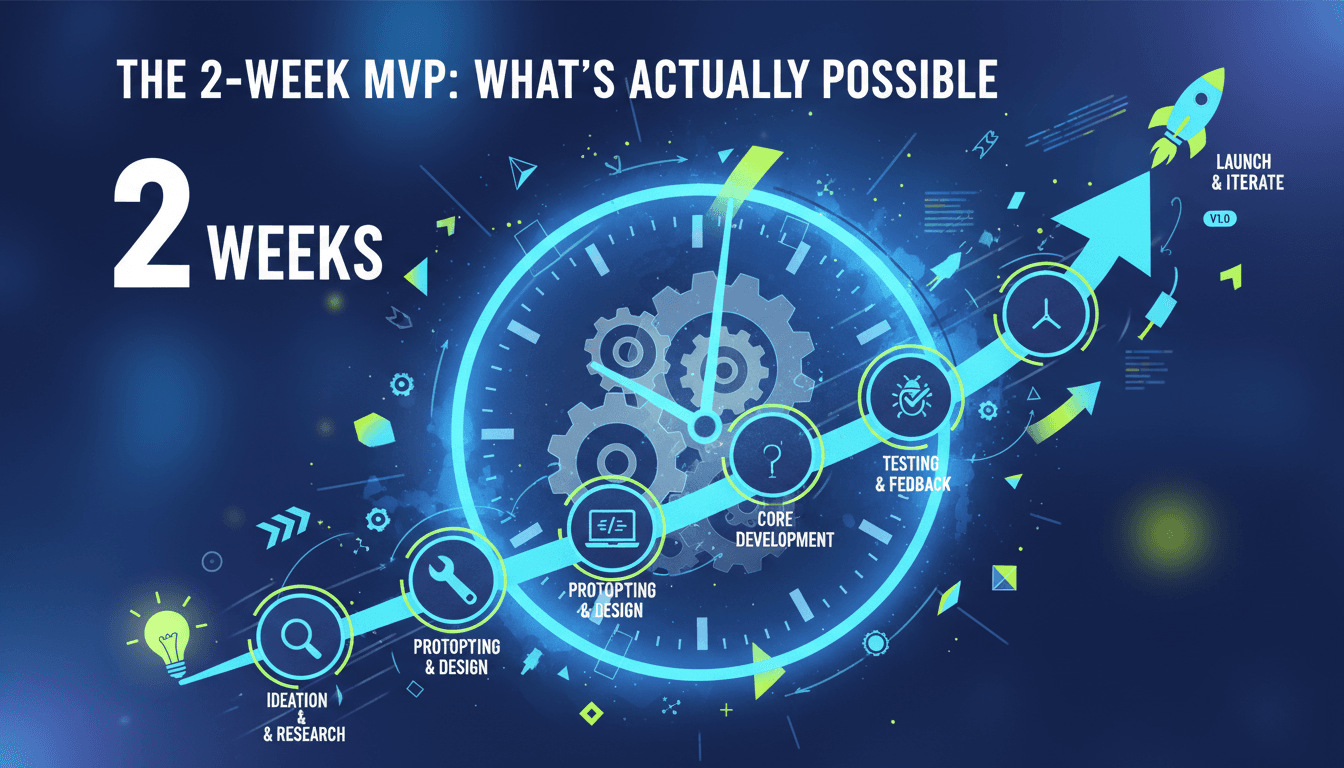
"Can you really build an MVP in 2 weeks? Yes, but only for specific types of products. Here's what's realistic, what's not, and how to maximize speed without disaster."
January 9, 2025 11 min read
"We need to ship an MVP in 2 weeks."
Sometimes this comes from a founder who watched too many Gary Vee videos. Sometimes it's a real constraint - demo for investors, competition launching, or expiring opportunity.
Either way, you need to know: can you actually build something meaningful in 2 weeks, or is this a fantasy that leads to wasted effort?
The answer: yes, but only for specific types of products, with very aggressive scope cuts, and realistic expectations about what "MVP" means.
Here's what's actually achievable in 10 working days, what's not, and how to make the most of an extremely compressed timeline.
What "2-Week MVP" Actually Means
Let's be specific about constraints. Two weeks means:
Calendar time:
10 working days (weekdays only)
Could be 14 calendar days if working weekends
Could be compressed to 7 calendar days with extended hours
The decision framework: If removing a feature means users can't complete your core workflow, it stays. Everything else goes.
The Technology Stack for Speed
Your tech stack choice determines whether 2 weeks is possible or not.
Fast stacks (use these):
Web apps:
Next.js + Vercel (deployment is instant)
Supabase (database + auth in one)
Shadcn UI (pre-built components)
Stripe (don't build payment processing)
E-commerce:
Shopify with theme (don't customize if possible)
WooCommerce if WordPress-savvy
Webflow + Shopify buy button for simple stores
No-code for speed:
Bubble for web apps (if you know it well)
Webflow for marketing sites
Airtable + Zapier for backends
Softr or Glide for simple apps
Slow stacks (avoid for 2 weeks):
Custom frameworks (Laravel, Django) unless very experienced
Custom design (Figma → code takes time)
Complex backends (microservices, graphQL)
Self-hosted infrastructure (DevOps adds days)
The rule: Use platforms that handle hosting, auth, database, and deployment. Every minute configuring infrastructure is a minute not building features.
The Day-by-Day Breakdown (What's Realistic)
Here's what 2 weeks actually looks like for a simple web app MVP.
Week 1:
Day 1: Setup and architecture (8 hours)
Project initialization
Authentication setup (NextAuth or Clerk)
Database schema design
Hosting deployment pipeline
Basic app structure
Day 2-3: Core feature development (16 hours)
Build primary feature (the one thing your product does)
Basic UI for main workflow
Database integration
Critical path working end-to-end
Day 4: User onboarding and auth (8 hours)
Signup/login flows
Email verification
Password reset
Onboarding experience
Day 5: Polish and cleanup (8 hours)
Fix obvious bugs
Add loading states
Basic error messages
Mobile responsive tweaks
Deploy to production
Week 2:
Day 6-7: Secondary features (16 hours)
User dashboard
Settings (minimal)
Any must-have supporting features
Email notifications (if critical)
Day 8: Payment integration (8 hours, if needed)
Stripe checkout
Payment confirmation
Basic subscription or one-time payment
Success/failure handling
Day 9: Testing and bug fixes (8 hours)
Manual testing of all flows
Fix critical bugs
Test on different devices
Edge case handling (where possible)
Day 10: Launch prep (8 hours)
Final deployment
Monitoring setup (Sentry for errors)
Basic analytics (PostHog or Mixpanel)
Documentation for yourself
Soft launch to first users
Total: 80 hours over 10 days.
This assumes no major blockers, minimal scope creep, and developer who knows the stack well.
The Pre-Work That Makes 2 Weeks Possible
You can't start cold and ship in 2 weeks. You need preparation.
Before the 2 weeks start:
Requirements definition (20-40 hours):
Crystal clear spec of the one core feature
User flows documented
Edge cases identified (even if you won't handle them all)
Success criteria defined
Design (if custom design needed):
Wireframes for all screens (can be rough)
Design system defined (colors, fonts, components)
No high-fidelity mockups (too slow)
Or: decide to use UI library and skip custom design
Tech stack decisions:
Framework chosen
Hosting platform selected
Auth service picked
Payment provider confirmed
Database and deployment pipeline decided
Assets collected:
Copy written (all the words on your site)
Images sourced or placeholders defined
Logo and branding basics
Legal pages (terms, privacy)
Total pre-work: 30-60 hours over the week before development starts.
The pattern: The 2-week sprint is purely development. All planning, design decisions, and requirements definition happen beforehand. Otherwise you're not shipping in 2 weeks.
The Wizard of Oz Approach: Fastest MVP Possible
The absolute fastest MVP is one where you manually do everything that looks automated.
Examples:
Example 1: Matching platform
Users submit profiles
"Algorithm" sends them matches
Reality: You manually review and send matches
Time saved: 40+ hours not building matching algorithm
Example 2: Content curation
App shows curated news/content
"AI-powered" curation
Reality: You manually select content daily
Time saved: 60+ hours not building recommendation engine
Example 3: Automated reports
Users request custom reports
System "generates" them
Reality: You run database queries and format manually
Time saved: 30+ hours not building report generator
When this works:
You can handle volume manually (under 50-100 users)
Users don't know it's manual
You're testing demand, not technical feasibility
You have time to do manual work
When to automate: After you prove demand and can't keep up manually.
The fastest MVPs are often 80% smoke and mirrors with 20% real infrastructure (auth, database, payment processing).
What Gets Skipped (And How to Survive Without It)
In 2 weeks, you're skipping a lot. Here's what goes and how to live without it.
No automated tests:
Manual test everything before deploying
Test critical path in production immediately after deploy
Add tests later when you have time
No comprehensive error handling:
Handle errors in critical path (signup, payment)
Let other errors crash with error tracking (Sentry)
Fix errors as they appear in production
No edge case handling:
Document known edge cases
Put warnings in UI ("This might not work if...")
Handle as bugs when users report them
No performance optimization:
Ensure it's not painfully slow
Accept 2-3 second load times
Optimize later when you have data on bottlenecks
No beautiful design:
Use UI library components as-is
Basic branding (colors, logo)
Functional beats beautiful
Redesign after you have users and feedback
The survival strategy: Have monitoring (Sentry for errors, analytics for usage) so you know when things break and can fix reactively.
The Team Configuration for Maximum Speed
One developer working 80 focused hours beats two developers trying to coordinate in 2 weeks.
The realistic timeline for most MVPs: 6-8 weeks. The 2-week MVP is for simple products where speed matters more than anything else.
If you're considering a 2-week MVP sprint and want an honest assessment of whether it's feasible for your product, talk to our team. We'll review your requirements and tell you if 2 weeks is realistic, or if you need 4-6 weeks to build something that actually works. Sometimes the right answer is "slow down to go faster."
/for-startups - Startup services including rapid MVP development
Chatbots are stateless. Agents accumulate state, make decisions, and run for minutes. Here are the 7 backend requirements that make or break production agents.