AI MVP: Build Custom vs Use Platforms vs Hire an Agency
Building an AI MVP? You have three paths: custom development, platforms, or hiring an agency. Here's the decision framework based on time, budget, and risk.
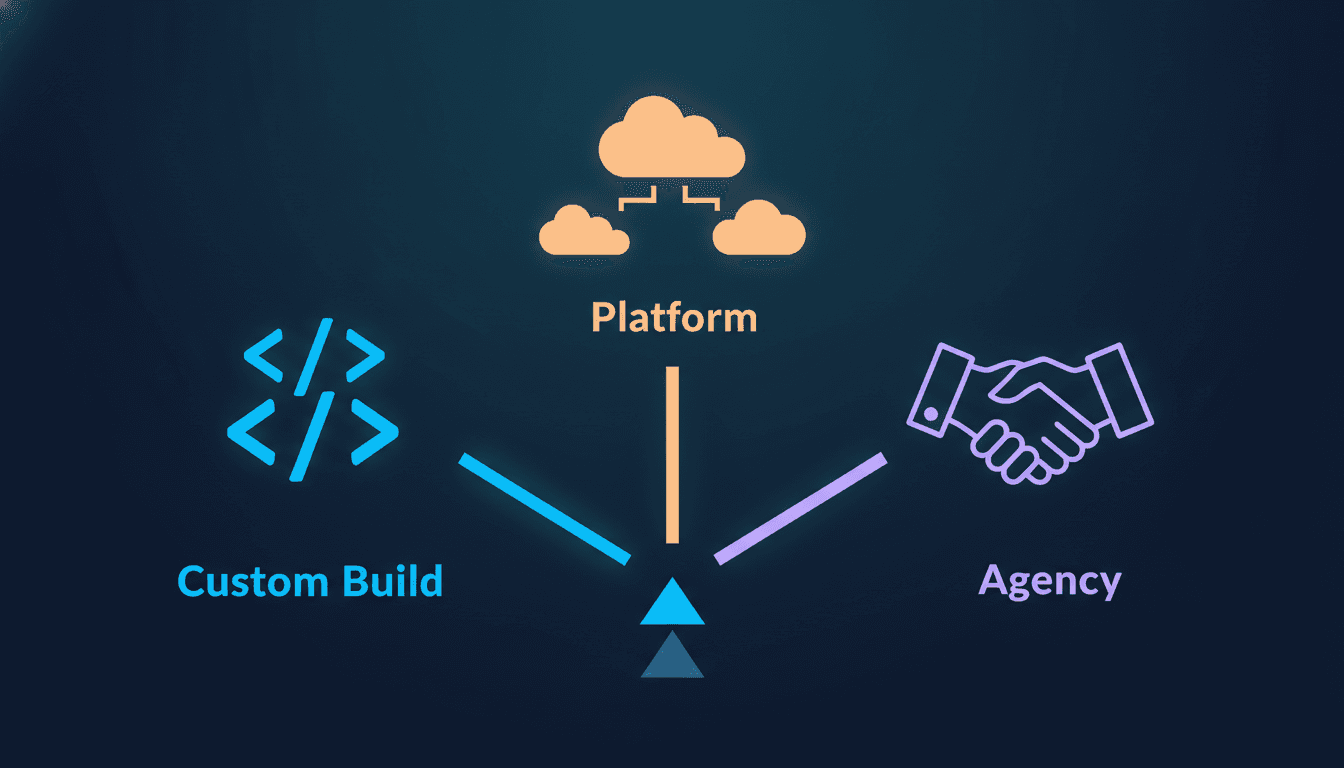
You need an AI MVP in 3 months. You have three options:
- Build it custom with your team
- Use existing AI platforms and tools
- Hire an agency to build it
Each path has different costs, timelines, and risks. Most startups choose wrong and waste months or money.
Here's the decision framework to know which path fits your situation.
The Three Paths Compared
Path 1: Build Custom
- Timeline: 3-6 months
- Cost: $50K-150K (team salary + infrastructure)
- Control: Complete
- Risk: High (technical complexity, timeline slippage)
Path 2: Use Platforms
- Timeline: 2-8 weeks
- Cost: $5K-30K (platform fees + light customization)
- Control: Limited to platform capabilities
- Risk: Medium (platform limitations, vendor lock-in)
Path 3: Hire Agency
- Timeline: 6-12 weeks
- Cost: $30K-100K (use our pricing calculator for estimates)
- Control: High (custom built, but managed by agency)
- Risk: Low-Medium (expertise mitigates risk, but dependency on agency)
No path is universally better. The right choice depends on your constraints and goals.
When to Build Custom
Building custom makes sense when you have specific conditions.
You should build custom if:
1. Your use case is genuinely unique
Not "unique" as in "our users are special." Unique as in "no existing tool can do this."
Example: Truly unique
"We're building an AI that analyzes 3D medical scans and generates treatment plans specific to rare genetic conditions."
No platform does this. You need custom models, custom pipelines, custom everything.
Example: Not actually unique
"We're building an AI chatbot for customer support in the e-commerce space."
This is standard. Platforms exist. Don't build custom.
2. You have strong AI/ML expertise in-house
Building AI features requires knowledge most engineering teams don't have:
- Prompt engineering and optimization
- Vector embeddings and similarity search
- LLM API nuances and error handling
- RAG architecture patterns
- Cost optimization strategies
If your team has this expertise, building custom is viable. If not, you'll spend 2-3 months learning before building anything useful.
3. You need full control over data and models
Some businesses can't use third-party platforms due to:
- Data privacy regulations (HIPAA, GDPR)
- Proprietary data that can't leave your infrastructure
- Custom model fine-tuning requirements
- Specific compliance needs
If data stays in-house by requirement, platforms won't work. Build custom or self-host.
4. Platform limitations are dealbreakers
Platforms have constraints:
- Fixed pricing that doesn't scale with your economics
- Limited customization of UI/UX
- API rate limits that block your use case
- Lack of specific integrations you need
If these block your product, build custom.
5. You're building a core differentiated feature
If AI is your product's competitive moat, build it custom. You need control and the ability to iterate rapidly without platform constraints.
Example:
A company building an AI coding assistant should build custom with dedicated AI development resources. An e-commerce company adding AI-powered search should use a platform.
When to Use Platforms
Platforms win when you want standard AI features fast.
You should use platforms if:
1. Your use case is standard
80% of AI features are standard:
- Customer support chatbot
- Semantic search over documents
- Content recommendations
- Email classification and routing
- Data extraction from documents
- Basic content generation
For these, platforms like OpenAI Assistants API, Intercom, Zendesk AI, Algolia AI Search, or specialized tools exist.
Why reinvent these?
2. Speed to market is critical
Platforms ship in weeks, custom builds take months.
Timeline comparison:
Custom chatbot:
- Architecture: 1 week
- Prompt engineering: 2 weeks
- UI development: 2 weeks
- Integration: 1 week
- Testing and refinement: 2 weeks
- Total: 8 weeks minimum
Platform chatbot (e.g., Intercom):
- Configure bot: 1 day
- Upload knowledge base: 1 day
- Test and refine: 3-5 days
- Deploy: 1 day
- Total: 1 week
If you need an MVP to validate product-market fit, platforms are 8x faster.
3. Your team lacks AI expertise
Building AI requires specific skills. If your team doesn't have them, platforms abstract the complexity.
Skills platforms handle for you:
- Prompt optimization
- Vector database management
- Embedding generation and search
- Context window management
- Error handling and retries
- Cost optimization
You focus on configuring, not building.
4. Budget is constrained
Custom development costs $50K-150K. Platforms cost $100-3,000/month.
First year costs:
Custom:
- Development: $80K
- Infrastructure: $500/month \* 12 = $6K
- Maintenance: $20K
- Total: $106K
Platform:
- Platform fees: $500/month \* 12 = $6K
- Setup/customization: $5K
- Total: $11K
Platforms are 10x cheaper for standard use cases.
5. You're validating, not scaling
Early-stage startups should validate before building. Platforms let you test hypotheses without major engineering investment.
Once validated, you can build custom if needed. But most features stay on platforms.
When to Hire an Agency
Agencies are the middle path: custom solutions without building the team.
You should hire an agency if:
1. You need custom but lack expertise
Your use case needs custom development, but your team doesn't have AI expertise.
Agency brings:
- Experienced AI developers
- Established architecture patterns
- Faster development (they've done this before)
- Lower risk (expertise reduces mistakes)
Cost comparison:
Hire in-house AI engineer:
- Salary: $150K-250K/year
- Recruiting: 2-4 months
- Ramp-up: 1-2 months
- Total time to productivity: 3-6 months
Hire agency:
- Cost: $50K-100K for MVP
- Start time: 1-2 weeks
- Ramp-up: Already know the patterns
- Total time to MVP: 6-12 weeks
Agencies are faster and de-risk early development.
2. You need to ship fast but platforms don't fit
Platforms are too limited. Custom in-house is too slow. Agencies thread the needle.
Example scenario:
You need a custom AI feature integrated into your existing product. It's not standard enough for platforms, but you need it in 2 months.
In-house team: Probably can't do it in 2 months (learning curve + development).
Agency: Can do it (they've built similar features).
3. You want to de-risk technical execution
Building AI features has risks:
- Wrong architecture decisions (expensive to fix)
- Poor prompt engineering (low accuracy)
- Inefficient implementation (high costs)
- Scope creep (timeline delays)
Agencies have built 10+ AI features. They know the pitfalls. This experience de-risks execution.
4. You plan to bring development in-house eventually
Agencies can build V1, then hand off to your team for V2+.
Hybrid path:
- Agency builds MVP (8-12 weeks)
- You validate with users
- Hire in-house AI engineer
- Transition to in-house development
- Agency provides support during transition
This gets you to market fast while building long-term capability.
5. You need ongoing AI development expertise
Some startups partner with agencies long-term. Agency becomes extended team.
When this works:
- You're building multiple AI features over time
- In-house team focuses on core product
- Agency handles AI feature development
- Cost is predictable monthly retainer
This is common in mid-sized startups (10-50 people) that need AI expertise but can't justify multiple full-time AI engineers.
The Decision Framework
Use this decision tree.
Question 1: Is your use case standard or unique?
Standard (chatbot, search, classification, content generation):
- Go to Question 2
Unique (custom models, novel approaches, specialized domain):
- Go to Question 3
Question 2: Do you need to ship in under 4 weeks?
Yes:
- Use platforms
- Accept limitations
- Validate first, customize later
No:
- Consider custom or agency depending on expertise
Question 3: Do you have AI expertise in-house?
Yes, strong expertise:
- Build custom
- You have the skills and can iterate quickly
No or limited expertise:
- Go to Question 4
Question 4: Is budget more constrained than timeline?
Budget is primary constraint:
- Use platforms (even if limited)
- Or start with agency for MVP, transition in-house
Timeline is primary constraint:
- Hire agency
- They'll deliver faster than building in-house
Question 5: Is AI a core product differentiator?
Yes (AI is the product):
- Build custom or hire agency initially
- Plan to bring in-house long-term
- Control and iteration speed matter
No (AI is a feature):
- Use platforms
- Focus engineering on core product
Cost Breakdown: Real Numbers
Here are actual costs for a mid-complexity AI feature (e.g., RAG-based knowledge assistant).
Path 1: Build Custom
Development (12 weeks, 2 engineers):
- Engineering cost: $150/hour 80 hours/week 12 weeks = $144K
Infrastructure (first year):
- Vector DB: $100/month \* 12 = $1,200
- Hosting: $200/month \* 12 = $2,400
- Monitoring: $100/month \* 12 = $1,200
- LLM API costs: $500/month \* 12 = $6,000
Total first year: $154,800
Path 2: Use Platforms
Platform fees (e.g., OpenAI Assistants API + custom UI):
- Platform: $200/month \* 12 = $2,400
- Custom UI development: $10,000 (one-time)
- Integration work: $5,000 (one-time)
- LLM API costs: $500/month \* 12 = $6,000
Total first year: $23,400
Path 3: Hire Agency
Agency development:
- MVP build: $60,000 (8 weeks)
- Infrastructure setup: Included
- LLM API costs: $500/month \* 12 = $6,000
- Maintenance retainer: $5,000/month \* 12 = $60,000 (optional)
Total first year: $66,000 (without retainer) or $126,000 (with retainer)
ROI consideration:
If your feature generates $10K/month in revenue, payback periods:
- Custom: 15.5 months
- Platform: 2.3 months
- Agency (no retainer): 6.6 months
Platform wins on ROI for standard features.
Timeline Comparison
Speed to market matters for startups.
Custom development:
- Weeks 1-2: Architecture and planning
- Weeks 3-6: Core development
- Weeks 7-10: Integration and testing
- Weeks 11-12: Refinement and optimization
- Total: 12 weeks to MVP
Platform:
- Week 1: Platform selection and setup
- Week 2: Configuration and integration
- Week 3: Testing and refinement
- Total: 3 weeks to MVP
Agency:
- Week 1: Discovery and planning
- Weeks 2-6: Development
- Weeks 7-8: Testing and refinement
- Total: 8 weeks to MVP
If you need to validate in 2 months, only platforms work.
Risk Assessment
Each path has different risk profiles.
Custom development risks:
- Technical complexity: High (learning curve for team)
- Timeline risk: High (often takes 2x estimated time)
- Cost overrun: High (unexpected complexity adds cost)
- Opportunity cost: High (team not building core product)
- Success probability: 60-70% (many fail or get abandoned)
Platform risks:
- Technical complexity: Low (abstracted)
- Timeline risk: Low (predictable)
- Cost overrun: Low (fixed pricing)
- Vendor lock-in: Medium-High (hard to migrate)
- Feature limitations: Medium-High (can't customize deeply)
- Success probability: 80-90% (low complexity)
Agency risks:
- Technical complexity: Low (agency handles it)
- Timeline risk: Medium (generally reliable but depends on agency)
- Cost overrun: Low-Medium (fixed bid reduces risk)
- Knowledge transfer: Medium (need good documentation)
- Dependency: Medium-High (rely on agency for changes)
- Success probability: 75-85% (expertise improves odds)
Risk tolerance should guide your choice.
Hybrid Approaches
You don't have to pick just one path.
Hybrid 1: Platform + Custom UI
Use platform for AI logic, build custom UI for better UX.
Example:
- OpenAI Assistants API for RAG backend
- Custom React app for user interface
- Best of both: fast backend setup, differentiated UX
Hybrid 2: Agency MVP + In-House Scaling
Agency builds V1, you build V2+ in-house.
Timeline:
- Months 0-2: Agency builds and ships MVP
- Months 3-4: Validate with users
- Month 5: Hire in-house AI engineer
- Month 6+: In-house team takes over
Hybrid 3: Platform + Custom Extensions
Start with platform, add custom features where needed.
Example:
- Base chatbot on Intercom
- Custom API for specialized queries
- Fallback to Intercom for standard questions
Common Mistakes
Watch for these failure modes.
Mistake 1: Building custom "because we can"
Engineering teams want to build. But building isn't always right.
Red flag: "We have smart engineers, we should build this ourselves."
Reality: Smart engineers are expensive. Use them for differentiated work, not rebuilding commodity features.
Mistake 2: Using platforms without checking limitations
Platforms have constraints. Check them before committing.
Red flag: "We'll start with Intercom and customize it later."
Reality: Platforms often can't be customized beyond their design. You might hit a wall and need to rebuild.
Mistake 3: Hiring agency without clear requirements
Agencies need clear specs. Vague requirements lead to expensive iteration.
Red flag: "We're not sure exactly what we need, but the agency will figure it out."
Reality: Agencies bill hourly for discovery. Unclear requirements = high costs.
Mistake 4: Building custom without AI expertise
Learning AI while building production features is expensive.
Red flag: "We'll learn as we go."
Reality: You'll make expensive mistakes and waste 2-3 months.
Mistake 5: Choosing based on cost alone
Cheapest option isn't always best. Consider total cost of ownership.
Example:
Platform is cheapest up-front ($5K), but if it doesn't meet needs, rebuilding custom costs $80K.
Starting with agency ($60K) might be cheaper than platform failure + custom rebuild.
The Validation Approach
For early-stage startups, validation matters more than technology.
Step 1: Validate with wizard of oz
Fake the AI. Human does it manually behind the scenes.
Cost: Basically free (some human time)
Timeline: 1 week
Learning: Do users want this feature?
Step 2: Validate with platform
If users want it, implement with platform.
Cost: $5K-10K
Timeline: 2-3 weeks
Learning: Do users use it? Is the value real?
Step 3: Build custom if needed
If usage is high and platform limits you, build custom.
Cost: $50K-100K
Timeline: 8-12 weeks
Learning: Optimize for scale and differentiation
This de-risks investment. Don't build custom until you've validated demand.
Your Decision Checklist
Answer these questions before choosing a path.
About your use case:
- [ ] Is this a standard AI feature or truly unique?
- [ ] Can existing platforms handle 80%+ of requirements?
- [ ] Are there specific platform limitations that block us?
About your team:
- [ ] Do we have AI/ML expertise in-house?
- [ ] Can we dedicate 2+ engineers for 3+ months?
- [ ] Is this a learning opportunity worth the time investment?
About your constraints:
- [ ] What's our timeline? (Weeks vs months)
- [ ] What's our budget? ($10K vs $100K+)
- [ ] What's our risk tolerance? (Low/Medium/High)
About your business:
- [ ] Is AI core to our product differentiation?
- [ ] Do we need full control over the implementation?
- [ ] Are we validating or scaling?
Scoring:
If 3+ answers point to platforms: Use platforms
If 3+ answers point to custom: Build custom or hire agency (based on expertise)
If split: Start with platform, plan transition to custom
When NextBuild (an Agency) Makes Sense
We're an agency, so we're biased. But here's when hiring us (or similar agencies) is the right call.
Hire NextBuild when:
1. You need custom AI features in 2-3 months
We've built dozens of AI features. We know the patterns. We ship fast.
2. Your team doesn't have AI expertise
We bring the knowledge. You focus on your core product.
3. You want to de-risk technical execution
We've made the mistakes already. You get proven architectures.
4. You need ongoing AI development capacity
Some clients use us as their extended AI team. Retainer-based relationship.
5. You're between "platform too limited" and "custom too slow"
We build custom features with agency speed.
Don't hire us when:
1. Your use case is standard and platforms work
We'll tell you to use Intercom or OpenAI Assistants API. No point paying us.
2. You have strong in-house AI expertise
If your team knows AI, build in-house. You'll iterate faster long-term.
3. Budget is under $30K
Agency work has a minimum viable scope. Below $30K, use platforms.
4. Timeline is under 4 weeks
Agencies need time for discovery, planning, and proper development. Platforms are faster for very quick timelines.
Ready to Choose Your Path?
The right path depends on your situation. There's no universal answer.
If you're still uncertain, talk to us. We'll honestly tell you if you should hire us, build in-house, or use a platform.
Or use our MVP calculator to estimate costs for your specific use case.
We help startups ship AI features that work. Sometimes that's with us. Sometimes it's not. Either way, we'll point you in the right direction.