Drizzle vs Prisma: Which ORM for Your Startup in 2026?
A practical comparison of Drizzle and Prisma ORMs for startup founders, with recommendations based on team SQL experience and deployment environment.
December 19, 2025 7 min read
Prisma 7 just dropped with a completely rewritten engine. 85-90% smaller bundle. 3.4x faster queries. Zero Rust dependencies.
Meanwhile, Drizzle hit 1.0 beta with a radically different philosophy: SQL-first, zero build step, edge-ready.
Both are strong choices for TypeScript startups. Neither is universally better. Your team's SQL comfort and deployment target determine which one wins.
The Core Philosophical Split
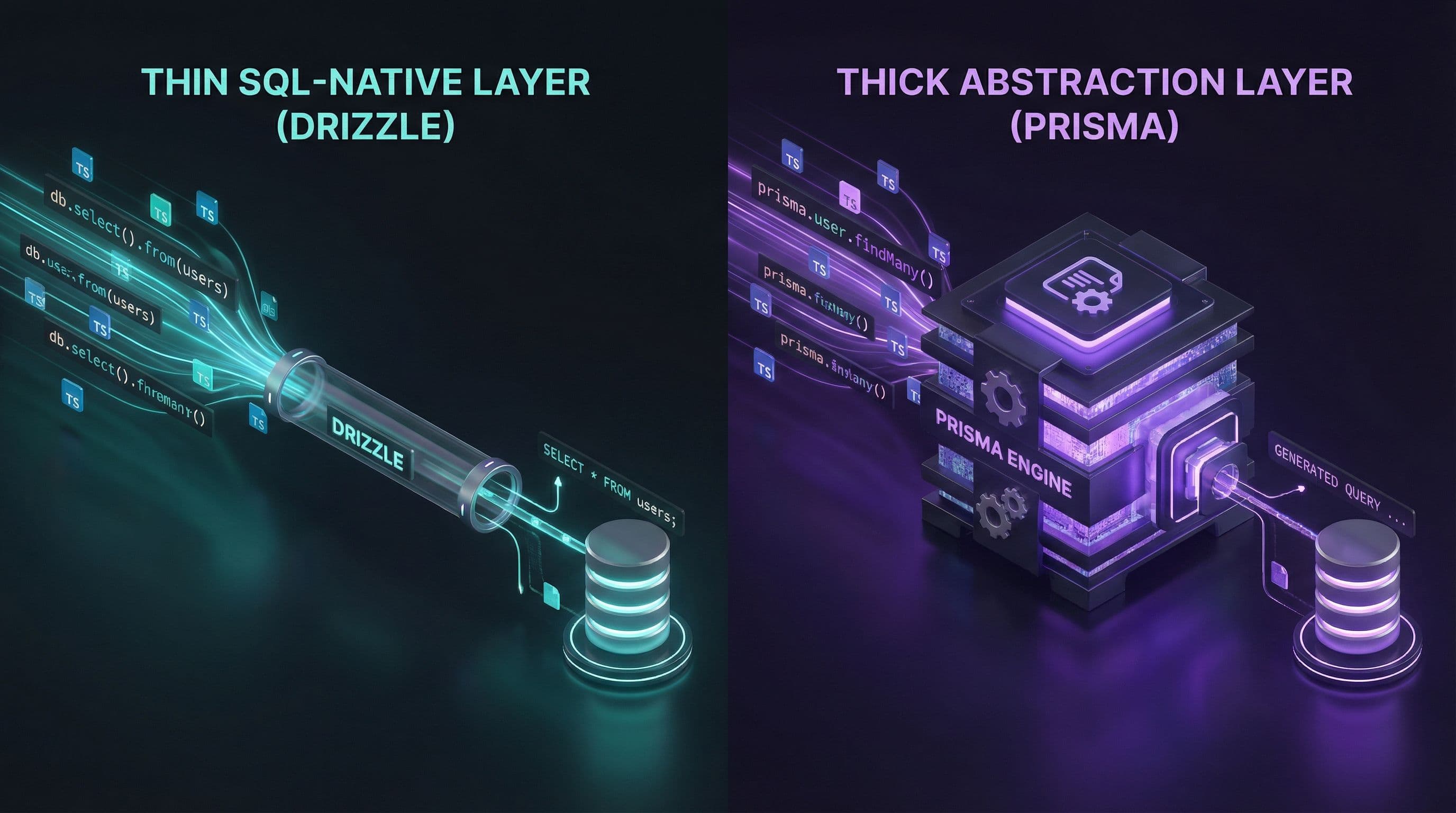
Prisma and Drizzle take opposite approaches to the same problem.
Prisma uses schema-first design. You define models in a .prisma file using Prisma's DSL. Run prisma generate to create TypeScript types and a query client. The abstraction layer is thick - Prisma hides SQL complexity.
Drizzle uses code-first design. You define schemas directly in TypeScript using builder functions. No code generation. No DSL to learn. The abstraction layer is thin - you're writing SQL with type safety.
The trade-off:
Prisma: Easier for teams without SQL expertise. Steeper learning curve for SQL experts who want control.
Drizzle: "If you know SQL, you know Drizzle." But you need to know SQL.
Bundle Size: Drizzle Wins by a Mile
Drizzle's bundle is ~7.4KB with zero dependencies. Perfect for edge deployments and serverless functions.
Prisma 7 made massive improvements - from 8-10MB down to 1.6MB. That's 85-90% smaller than Prisma 6. But it's still 216x larger than Drizzle.
Stop planning and start building. We turn your idea into a production-ready product in 6-8 weeks.
Vercel/Netlify cold starts: Smaller bundles mean faster function spin-up times
Edge deployment: Drizzle works on Cloudflare Workers out of the box
Mobile apps: If you're building React Native with a backend, smaller bundles reduce app size
Prisma's 1.6MB bundle is acceptable for most server deployments. But if you're deploying to edge environments or optimizing for cold starts, Drizzle's size advantage is significant.
Performance: Close Enough for Most Startups
Drizzle runs near-raw SQL performance because it's a thin wrapper. Minimal overhead.
Prisma 7 closed the gap significantly. 3.4x faster queries than Prisma 6. Query execution is now competitive for typical CRUD operations.
Real talk: For 95% of MVPs, you won't notice the difference. Your bottleneck is usually database round-trips, not ORM overhead.
Where performance matters:
High-throughput APIs: If you're building fintech transaction processing or real-time trading, Drizzle's zero-overhead approach gives you headroom
Complex queries: Drizzle's SQL-first design lets you optimize with raw SQL when needed
Edge compute: Drizzle's small footprint + fast execution wins for edge deployments
Type Safety: Prisma Wins for Large Teams
Prisma's type-checking is 70% faster in v7. For large schemas (100+ tables), this matters when your editor is re-validating types constantly.
Drizzle's type inference improved dramatically in v1.0, but Prisma still has the edge for massive schemas with deep relationships.
For most startups (10-30 tables at MVP stage), both provide excellent TypeScript autocomplete and type safety. The difference shows at scale.
Developer Experience: Depends on Your SQL Comfort
If your team knows SQL well:
Drizzle feels natural. You write TypeScript that looks like SQL. No context switching. No DSL to learn.
Example Drizzle query:
It's SQL. With types.
If your team is SQL-averse:
Prisma's abstraction layer is a feature, not a bug. You define relationships in the schema file, and Prisma generates intuitive queries.
Example Prisma query:
More Rails-like. Less SQL-like.
Prisma Studio (the GUI database browser) is also a major DX win. Drizzle has third-party tools, but nothing as polished.
Migration Workflow: Different Philosophies
Prisma migrations are schema-driven:
Edit your .prisma schema file
Run prisma migrate dev to generate migration SQL
Prisma creates and applies migrations automatically
Prisma infers schema changes and handles migration generation. Great for teams that don't want to write raw SQL migrations.
Drizzle migrations are code-driven:
Edit your TypeScript schema
Run drizzle-kit generate to create migration files
Review and apply migrations manually
Drizzle gives you more control but requires more SQL knowledge. You can write custom migration logic when needed.
For startups: Prisma's automated approach reduces migration errors early on. Drizzle's manual approach gives experienced teams precision.
Edge Deployment: Drizzle Is Built for It
Drizzle was designed for edge-first deployment. It works natively on:
Cloudflare Workers
Vercel Edge Functions
Deno Deploy
Bun
Prisma 7 added edge support with Prisma Accelerate (their connection pooler), but it requires a separate service and adds latency.
If you're building on edge infrastructure, Drizzle is the obvious choice. If you're deploying to traditional Node servers (Vercel serverless, Railway, Fly.io), either works fine.
Learning Curve and Ecosystem
Prisma has the maturity advantage:
Extensive documentation with real-world examples
Large community (600K+ weekly npm downloads)
Prisma Studio for database inspection
First-class support for most SQL databases
Drizzle is the scrappy challenger:
Growing community but smaller ecosystem
Documentation assumes SQL familiarity
Lighter tooling (no official GUI)
Faster adoption of new database features (better Postgres support)
Prisma's ecosystem means faster onboarding for junior developers. Drizzle's lightweight approach means less magic to debug when things break.
When to Choose Prisma
Use Prisma if:
Your team includes non-SQL developers who need abstraction
You're deploying to traditional Node environments (not edge)
You want a mature ecosystem with proven production deployments
You value guardrails over control in database operations
You need Prisma Studio for non-technical team members to inspect data
Prisma is the safer bet for mixed-skill teams and conventional architectures.
When to Choose Drizzle
Use Drizzle if:
Your team knows SQL and wants full control
You're deploying to edge environments (Cloudflare, Vercel Edge)
Bundle size matters for cold starts or mobile backends
You want zero build steps and minimal abstraction
You need near-raw SQL performance for high-throughput APIs
Drizzle is the better choice for experienced teams optimizing for edge deployment and performance.
What NextBuild Actually Uses
We don't use either.
NextBuild projects run on Convex, not SQL databases. Convex is a serverless backend that handles data, auth, file storage, and real-time sync without needing an ORM.
Why we chose Convex over SQL + ORM:
No migration management: Schema evolves with code, no separate migration files
Real-time by default: Reactive queries without WebSocket setup
Zero cold starts: Always-on infrastructure, not lambda spin-up
For startups building modern SaaS applications, Convex eliminates the entire ORM decision. You write TypeScript functions, and Convex handles the database layer.
That said, if you're committed to SQL (regulated industries, existing database, enterprise requirements), both Prisma and Drizzle are solid choices.
We've worked with both in client projects. For SQL-based architectures, we typically recommend Prisma for teams without deep SQL expertise and Drizzle for experienced backend developers optimizing for edge deployment.
Common Mistakes Teams Make
Choosing Drizzle without SQL knowledge: Drizzle's simplicity is deceptive. If your team doesn't understand indexes, joins, and query optimization, you'll struggle. Prisma's abstractions prevent common SQL mistakes.
Choosing Prisma for edge deployment: Prisma Accelerate works, but it adds complexity and latency. If edge is your deployment target, Drizzle's native support is simpler.
Over-optimizing for performance at MVP stage: Unless you're building high-frequency trading or real-time gaming, ORM performance doesn't matter yet. Focus on shipping. Optimize later.
Ignoring migration complexity: Both ORMs handle migrations differently. Test your migration workflow in staging before production. Schema changes cause outages if mishandled.
Key Takeaways
Prisma 7: 85% smaller bundle, 3.4x faster, mature ecosystem - best for teams with mixed SQL experience
Drizzle 1.0: 7.4KB bundle, edge-native, SQL-first - best for experienced teams deploying to edge environments
Performance: Close enough for most startups; Drizzle has the edge for high-throughput workloads
Bundle size: Drizzle wins decisively (7.4KB vs 1.6MB)
Developer experience: Prisma abstracts SQL; Drizzle embraces it
Edge deployment: Drizzle is built for it; Prisma requires workarounds
If your team knows SQL and you're deploying to edge, choose Drizzle. If you want mature tooling and abstraction, choose Prisma. If you want to skip the ORM decision entirely, consider a backend-as-a-service like Convex.
Need help choosing the right backend architecture for your startup? We've built MVPs on SQL, NoSQL, and BaaS platforms. Let's talk about which stack fits your timeline and team.
Document automation can cut drafting time from 3 hours to 15 minutes. But most MVPs fail by building too much too soon. Here are the 5 features that actually matter.