GPT-4 vs Claude vs Mistral vs LLaMA: A Founder's Decision Framework
Choosing between GPT-4, Claude, Mistral, and LLaMA isn't about picking the 'best' model—it's about matching capabilities to your business needs and budget. Here's the decision framework that actually matters.
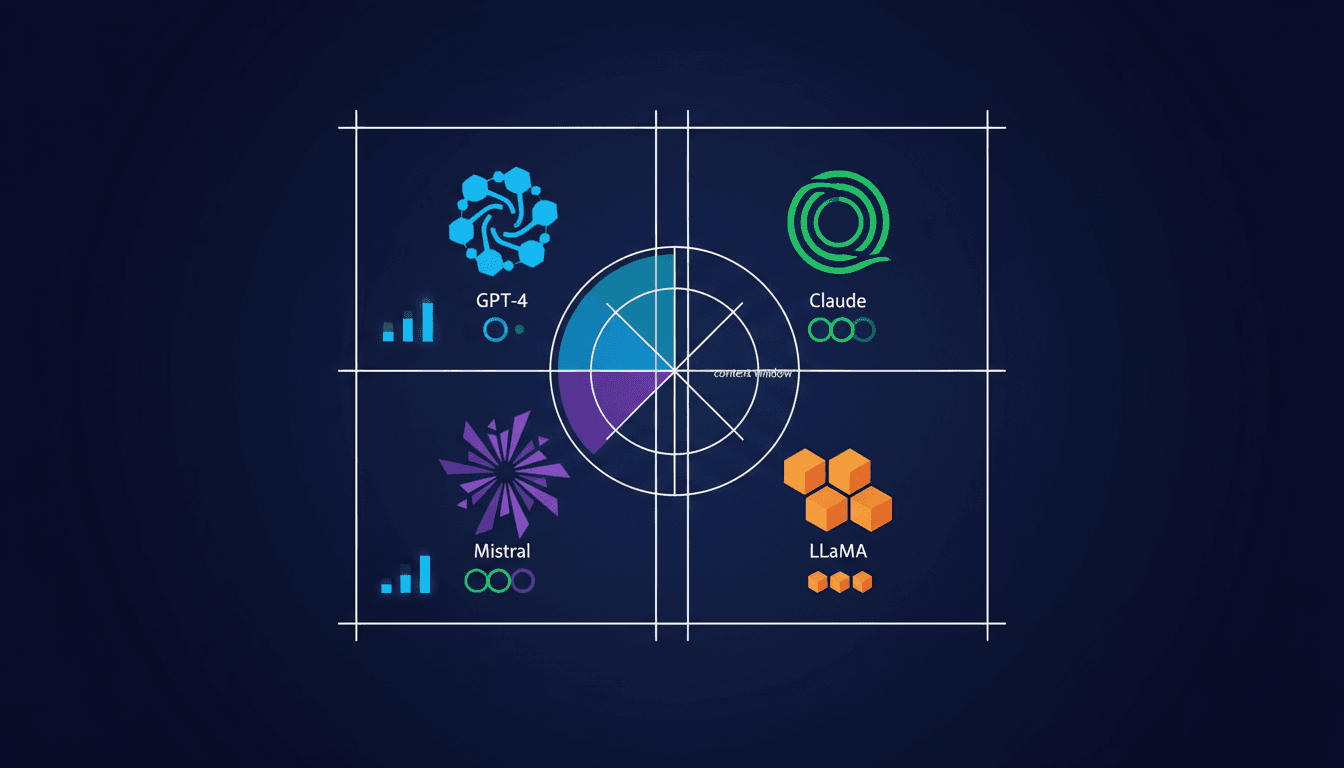
The question "Which LLM should I use?" gets asked in every founder call. The answer is never simple, because the right model depends on what you're building, how much you're willing to spend, and what trade-offs you can live with.
This isn't a technical deep-dive. This is a business decision framework based on shipping AI products for the last two years.
The Real Cost Comparison (January 2026)
Stop looking at benchmark scores. Start looking at your bill.
GPT-4o:
- $5 per 1M input tokens
- $15 per 1M output tokens
- 128K context window
Claude Sonnet 4.5:
- $3 per 1M input tokens
- $15 per 1M output tokens
- 200K context window
Claude Opus 4.5:
- $5 per 1M input tokens
- $25 per 1M output tokens
- 200K context window
Mistral Large 2:
- $2 per 1M input tokens
- $6 per 1M output tokens
- 128K context window
LLaMA 3.1 70B (via Together):
- $0.88 per 1M tokens (combined)
Gemini 1.5 Flash:
- $0.075 per 1M input tokens
- $0.30 per 1M output tokens
- 1M+ context window
The spread between the most and least expensive option is 60x. That compounds fast.
When You Actually Need GPT-4o
GPT-4o is the safe choice. It's also expensive and often overkill.
Use GPT-4o when:
You need maximum reliability. GPT-4o has the most battle-tested inference infrastructure. When you're launching to production and can't afford downtime, OpenAI's scale matters.
Your use case demands broad knowledge. If you're building something that requires answering questions across vastly different domains—customer support for a SaaS product, content generation across industries—GPT-4o's training breadth wins.
You have complex reasoning requirements. Multi-step logical tasks, code generation with intricate dependencies, planning and scheduling problems. GPT-4o handles these better than most alternatives.
You're in a regulated industry. OpenAI has the most mature compliance documentation and security certifications. If you need SOC 2, HIPAA, or GDPR attestations, the path is clearer.
Don't use GPT-4o for:
- High-volume, simple classification tasks (you'll burn money)
- Conversational interfaces where personality matters more than precision
- Anything where you're trying to stay under $500/month in API costs
When Claude Makes More Sense
Claude Sonnet 4.5 is underrated for production use cases. It's 40% cheaper on input tokens than GPT-4o and handles longer context better.
Use Claude when:
You need to process long documents. 200K context window vs 128K makes a real difference when you're analyzing contracts, research papers, or lengthy codebases. You can fit more without chunking.
Your product requires nuanced writing. Claude's outputs feel more natural in conversational contexts. If you're building a writing assistant, content tool, or anything user-facing where tone matters, test Claude first.
You want to minimize hallucinations. Claude is more likely to say "I don't know" than to fabricate information. For medical, legal, or financial use cases where accuracy trumps creativity, this behavioral difference matters.
You're building developer tools. Claude excels at code understanding and generation. If your AI feature involves reading, writing, or debugging code, it often outperforms GPT-4o in blind tests.
Claude Opus 4.5 exists for the edge cases where you need the absolute best reasoning, but at $25/1M output tokens, you should have a clear ROI story before reaching for it.
The Mistral Large 2 Sweet Spot
Mistral doesn't get enough attention from US founders. That's a mistake.
At $2 input / $6 output, Mistral Large 2 is 60% cheaper than GPT-4o and 33% cheaper than Claude Sonnet. The performance gap is smaller than the price gap.
Use Mistral when:
You're cost-conscious but need more than a toy model. Mistral Large 2 punches above its price point. For most business applications, the quality difference from GPT-4o isn't noticeable to end users.
You're building a European product. Mistral is EU-based, which simplifies GDPR compliance and data residency requirements. If your customers care about data sovereignty, this is your answer.
You need function calling and structured outputs. Mistral's function calling implementation is solid and well-documented. If you're building agents that need to interact with APIs, it's a reliable choice.
You want to hedge vendor risk. Don't put all your eggs in the OpenAI basket. Mistral gives you a credible alternative that's easy to switch to if OpenAI pricing or terms change.
The downside: smaller ecosystem, fewer integrations, less community support. If you need hand-holding, stick with OpenAI or Anthropic.
The Open-Source LLaMA Option
LLaMA 3.1 70B via Together AI costs $0.88 per 1M tokens. That's 17x cheaper than GPT-4o and 9x cheaper than Mistral.
Use LLaMA when:
You have high-volume, low-margin use cases. Content moderation, spam detection, simple classification, sentiment analysis. Anywhere you're processing millions of tokens per day and GPT-4o would bankrupt you.
You need full control and customization. You can fine-tune LLaMA on your own infrastructure. You can modify the model architecture. You can run it on-premise if data can't leave your network.
You're willing to trade convenience for cost. LLaMA isn't plug-and-play. You need to handle infrastructure, model hosting, and version management. But if you have the engineering capacity, the economics make sense.
You want to experiment without budget anxiety. At sub-$1 per million tokens, you can prototype aggressively without watching your burn rate.
Don't use LLaMA if:
- You need guaranteed uptime and SLAs
- Your team lacks ML ops experience
- You're optimizing for speed to market over cost
The Gemini Flash Dark Horse
Gemini 1.5 Flash is absurdly cheap: $0.075 input / $0.30 output. That's 66x cheaper than GPT-4o on input and 50x cheaper on output.
Use Gemini Flash when:
You're prototyping and need to move fast. At these prices, you can build, test, and iterate without thinking about cost. Perfect for validating ideas before committing to an architecture.
You have extreme context requirements. 1M+ token context window is unmatched. If you're building RAG systems that need to reference entire codebases or document sets, Gemini Flash changes the economics.
You're okay with Google's ecosystem. Vertex AI integration, Google Cloud billing, GCP-native tooling. If you're already all-in on Google, Gemini Flash is a no-brainer.
The catch: performance is a step down from GPT-4o and Claude Sonnet. You're trading quality for cost. Run tests before committing.
The Decision Framework: Start Here
Stop overthinking this. Here's the actual framework:
Step 1: Define your quality threshold.
Run a blind test with 20-50 examples of your specific use case. Have humans rate outputs from GPT-4o, Claude Sonnet, and Mistral Large. If users can't tell the difference, you don't need the expensive option.
Step 2: Model your costs at scale.
Estimate your monthly token usage at 10x, 100x, and 1000x your launch volume. If GPT-4o costs more than $5,000/month at 100x scale, you need a cheaper model or a different business model. Use our MVP calculator to estimate costs across different model choices.
Step 3: Identify your constraints.
- Compliance requirements: OpenAI or Claude
- European customers: Mistral or self-hosted LLaMA
- Developer tooling: Claude
- Extreme cost sensitivity: LLaMA or Gemini Flash
- Long-context needs: Claude or Gemini Flash
Step 4: Build with fallbacks from day one.
Abstract your LLM calls behind an interface. Make it trivial to switch models. The market changes every quarter—vendor lock-in will cost you.
What Most Startups Actually Need
Here's the honest recommendation for a typical B2B SaaS startup adding AI features:
Start with Claude Sonnet 4.5. It's the best balance of cost, performance, and context length for 80% of use cases. The 200K context window means fewer RAG headaches, and the output quality is excellent.
Use Gemini Flash for prototyping. Build your first version on Gemini Flash to validate the feature without spending real money. Once you know it works, upgrade to Claude or GPT-4o for production.
Keep Mistral as your backup. Implement a fallback to Mistral Large 2 if Claude has an outage or changes pricing. You want options.
Reserve GPT-4o for features that justify the premium. Complex reasoning, mission-critical reliability, or use cases where you've proven that cheaper models don't meet the quality bar.
Ignore LLaMA unless you have dedicated ML ops. The cost savings are real, but the operational complexity isn't worth it for most early-stage startups. Revisit this at scale.
The Mistake Everyone Makes
Founders pick a model based on benchmarks or hype, then design their entire product around it. That's backwards.
Figure out what you need to build. Test multiple models against your specific use case. Choose based on results, not reputation.
The best model is the one that meets your quality threshold at the lowest cost with acceptable vendor risk. Everything else is marketing. When you're building AI development into your product, this decision framework prevents costly mistakes.
Next Steps
The only way to know which model works for your use case is to test it with real data. Not synthetic benchmarks, not blog post recommendations—your actual use case with your actual users.
If you're building an AI feature and want help designing a proper evaluation framework, we've done this for dozens of products. We'll help you test models, estimate costs, and build with the right abstractions so you're not locked in.
Calculate your AI feature cost or talk to us about which model makes sense for what you're building.