Micro-SaaS MVP: The Focused Product Playbook
Build a micro-SaaS product with laser focus. Learn how to scope, build, and launch a focused product that solves one problem exceptionally well.
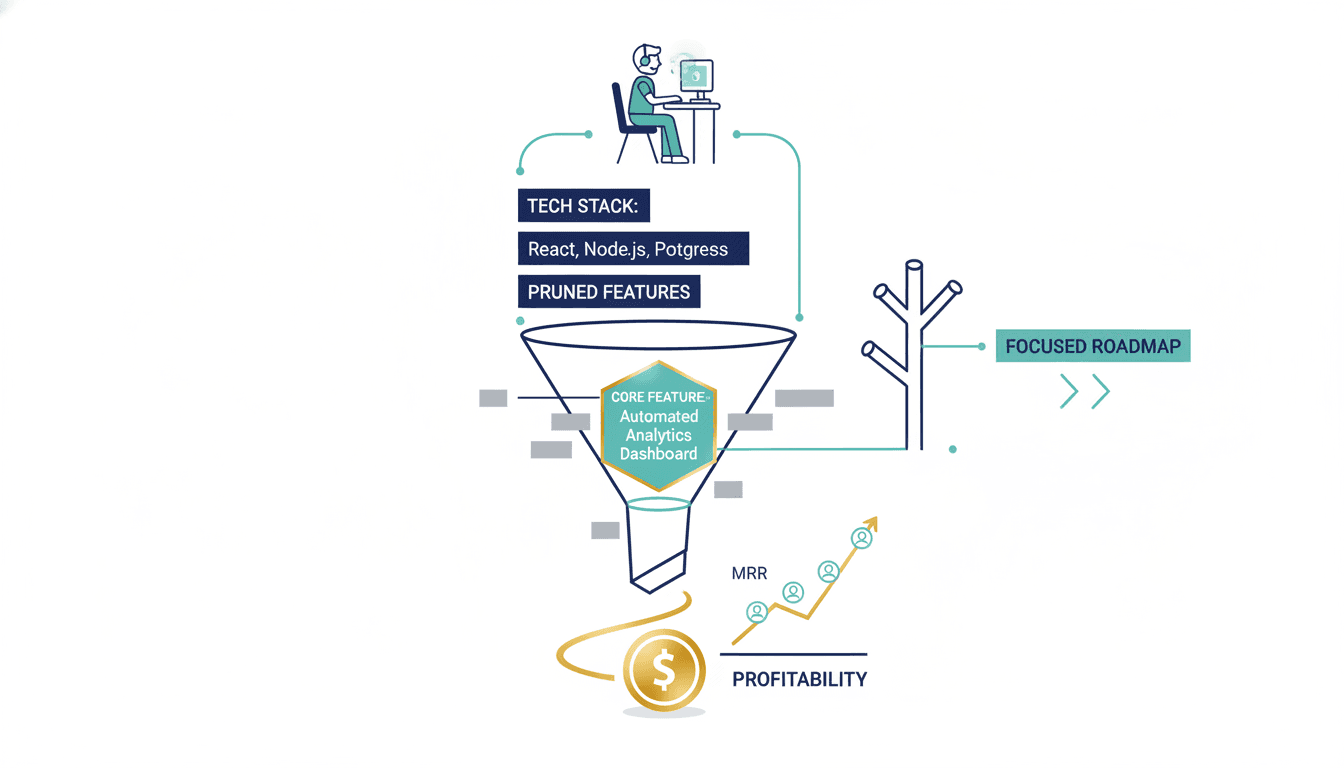
Micro-SaaS is the antithesis of the "raise millions, grow at all costs" playbook. It's a software business designed for profitability from the start, typically run by one person or a tiny team, solving a narrow problem extremely well.
The micro-SaaS approach works because it embraces constraints. Small market? Fine—you only need a few hundred paying customers. Limited engineering resources? Good—it forces you to build only what matters.
What Makes Micro-SaaS Different
Traditional SaaS optimizes for growth. Raise money, hire fast, capture market share, worry about profitability later. Micro-SaaS inverts the priorities: profitability over growth, narrow over broad, simple over feature-rich, solo or small team over large organization.
The goal isn't to build a unicorn. It's to build a sustainable business that generates meaningful income without consuming your life.
Choosing the Right Problem
Problem selection is 80% of micro-SaaS success. The ideal problem has these characteristics:
- Painful but not mission-critical - Important enough to pay for, not important enough for enterprises to build in-house
- Recurring need - Users need the solution regularly, not once
- Willingness to pay - The target users actually pay for software
- Fragmented market - Big players haven't consolidated the space
- Clear boundaries - You can fully solve it without building a platform
Scope Like Your Runway Depends on It
Micro-SaaS MVPs fail when founders build too much. Challenge yourself: what if your MVP only had one feature? Not one category. One feature. The single capability that solves the core problem.
Features that can almost always wait: team/collaboration features, integrations, analytics dashboards, mobile apps, notification customization, billing flexibility. Start with one price tier.
Technical Decisions for Solo Builders
Choose boring technology with strong documentation, large communities, and proven stability. For most micro-SaaS: Next.js, a backend-as-a-service like Convex, and deployment on Vercel. This stack handles 90% of micro-SaaS needs.
Set up authentication and payments first. Clerk or WorkOS for auth. Stripe for payments. Both have excellent documentation. Building these first means you can launch as soon as your core feature works.
Pricing for Profitability
Start with one price. Multiple tiers add complexity without proportional benefit. Calculate target monthly revenue divided by realistic customers. If you want $5,000/month and think you can get 100 customers, charge $50/month.
Charge more than you think. $10/month attracts price-sensitive users who churn easily. $50/month attracts users committed to solving the problem. $200/month attracts users who see software as a business expense.
Offer annual plans with a discount (typically 2 months free). Reduces churn, improves cash flow, signals commitment.
Launch Strategy for Micro-SaaS
Don't wait for a "big launch." Ship and tell people. Day 1: Product is live. Days 2-7: Tell 20-30 people individually (emails, DMs, not broadcasts). Weeks 2-4: Incorporate feedback, fix issues. Month 2+: Begin broader marketing.
Individual outreach beats broad announcements. A personal message to someone with the problem converts better than a Twitter thread to random followers.
Growing Without a Team
Focus on channels that don't require constant effort: SEO content (ranks and drives traffic indefinitely), word of mouth, integration listings in app directories, affiliate programs.
Profitability milestones: $1K MRR (proof of concept), $5K MRR (serious side income), $10K MRR (full-time sustainable), $20K+ MRR (comfortable single-person business).
Common Micro-SaaS Mistakes
Building a Platform Instead of a Product: "A flexible tool for any workflow" is a platform. "Invoice tracking for freelance designers" is a product. Products are easier to build, sell, and maintain.
Premature Automation: Early on, manually send onboarding emails, handle edge cases, process requests. Automate when the manual process is truly painful at your scale.
Feature Creep After Launch: For each potential feature, ask: Will this meaningfully reduce churn or increase conversion? Most answers should be no.
Ignoring Churn: 5% monthly churn means losing half your customers yearly. Track why users cancel, look for patterns, address root causes.
Key Takeaways
Micro-SaaS success comes from focus, not scale.
- Choose problems carefully: narrow, recurring, with willingness to pay
- Scope ruthlessly: one feature is often enough for launch
- Use boring tech: optimize for speed and solo maintainability
- Price for profit: charge more than feels comfortable, offer annual plans
- Launch quickly: soft launch to individuals, iterate, launch again
The goal is a profitable business, not the biggest business. Micro-SaaS is a path to independence, not a stepping stone to venture scale.
At NextBuild, we help founders build focused micro-SaaS products with lean MVPs and sustainable architectures.