Neon vs PlanetScale: Serverless Database for Your Startup
A practical comparison of Neon and PlanetScale for startup founders choosing a serverless database, with clear recommendations based on workload and budget.
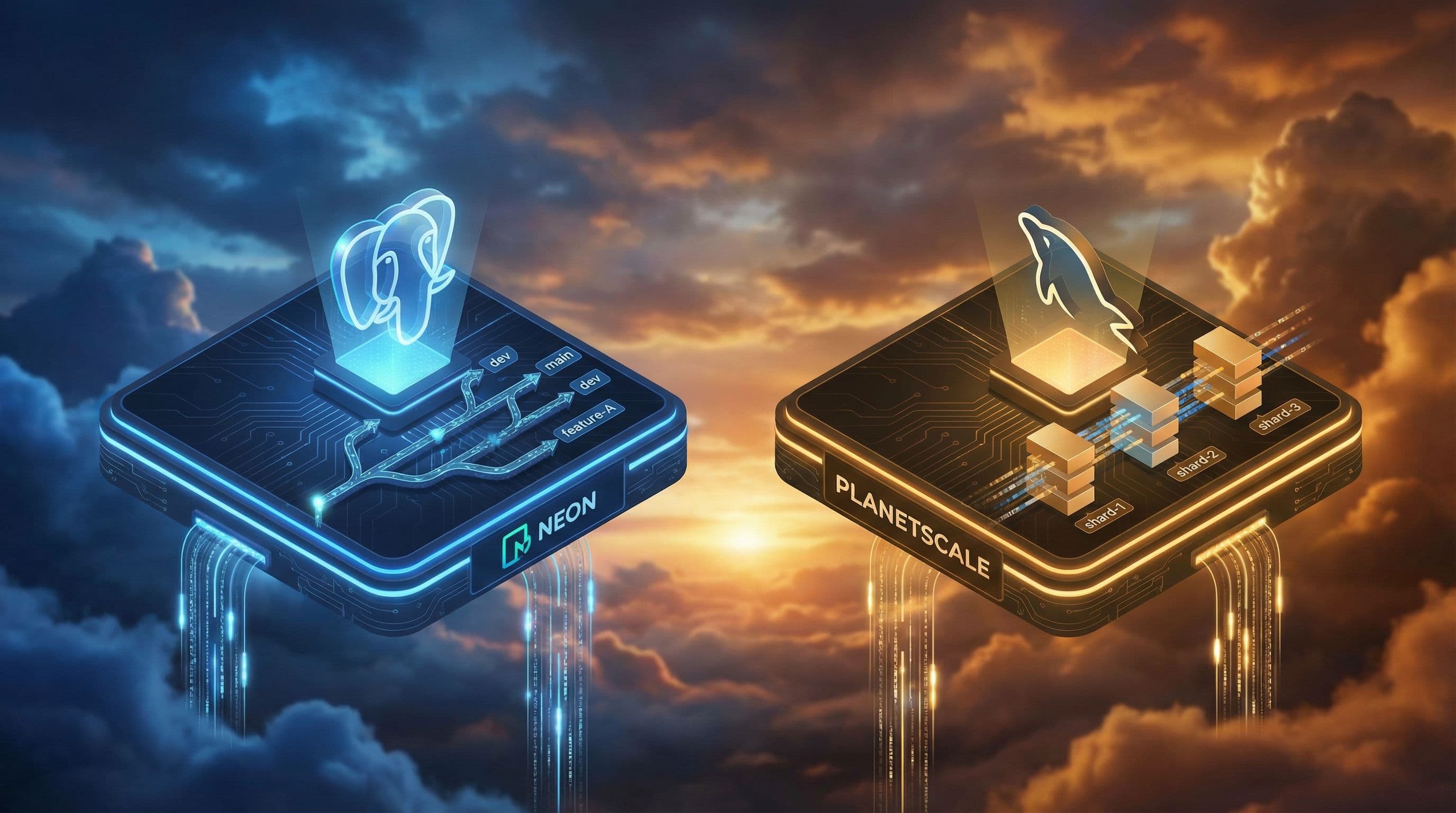
The serverless database market changed dramatically in 2024-2025. PlanetScale eliminated their free tier. Neon got acquired by Databricks for $1B and slashed storage costs by 80%. These shifts make your choice between these two platforms more consequential than ever.
Both promise "serverless" databases, but they deliver fundamentally different experiences. Neon gives you PostgreSQL with branching like Git. PlanetScale gives you MySQL with Vitess sharding for massive scale. The right choice depends on your workload, team preferences, and how much you're willing to pay for features you might not need yet.
What You're Actually Comparing
Neon and PlanetScale take opposite approaches to serverless databases.
Neon's philosophy: PostgreSQL compatibility first, developer experience second, scaling third. They built serverless on top of Postgres, which means you get the full ecosystem (Prisma, Drizzle, PostGIS, JSONB queries) without compromise. Their instant branching feature treats databases like Git branches—copy production data to staging in seconds, run tests, discard the branch.
PlanetScale's philosophy: Horizontal scaling first, MySQL compatibility second, developer experience third. They wrapped Vitess (YouTube's sharding infrastructure) in a serverless API. This means unlimited connections and the ability to shard at 250GB+, but also means no foreign key constraints by default and friction with ORMs expecting standard MySQL behavior.
The technical differences cascade into everything else: pricing, performance, workflow, and which problems you'll actually solve versus which ones you'll inherit.
Pricing Reality Check
PlanetScale killed their free tier in April 2024. If you want to use PlanetScale today, you start at Scaler Pro tier with a minimum monthly commitment. Neon still offers a generous free tier with 100 compute-unit hours per month.
Neon's free tier includes:
- 100 CU-hours/month (enough for side projects or early MVPs)
- 0.5 GB storage
- Instant branching with real data
- Community support
Neon's paid pricing:
- Compute scales automatically, billed per hour
- Storage dropped to $0.35/GB (down from $1.75 in 2024)
- Scale Launch at $19/month for production workloads
- Scale Pro for autoscaling and point-in-time recovery
PlanetScale's current pricing:
- No free tier—minimum Scaler Pro required
- Higher baseline cost for entry
- Non-blocking schema migrations included
- Unlimited connections via Vitess proxy
For bootstrapped founders, Neon's free tier lets you validate product-market fit before database costs kick in. For funded startups burning through AWS credits, PlanetScale's lack of a free tier matters less than their operational advantages at scale.
The storage price drop at Neon (80% reduction) makes them significantly cheaper for data-heavy applications. If your product stores user uploads, analytics logs, or large JSON blobs, Neon's economics win decisively.
Performance: Where Each One Wins
Benchmarks show PlanetScale delivers 22% faster writes than Neon in standard workloads. Neon performs better on read-heavy workloads with complex queries leveraging PostgreSQL's query planner.
PlanetScale performance advantages:
- Faster write throughput for transactional workloads
- Horizontal sharding for datasets over 250GB
- Unlimited concurrent connections (Vitess proxy handles pooling)
- Consistent latency under high connection load
Neon performance advantages:
- Better query optimization for complex JOINs
- JSONB indexing and full-text search built-in
- Read replicas for analytics queries
- Scale-to-zero without cold start penalties
If you're building a high-write SaaS (chat app, collaboration tool, real-time analytics), PlanetScale's write performance advantage matters. If you're building a content platform, directory, or marketplace with complex filtering, Neon's PostgreSQL query planner pays dividends.
The "scale-to-zero" feature at Neon deserves special attention. Your database shuts down during inactivity and wakes up in milliseconds when needed. This sounds trivial until you're running 15 staging environments for feature branches—Neon charges you nothing for idle databases. PlanetScale keeps compute running.
PostgreSQL vs MySQL: More Than Syntax
Choosing between Neon and PlanetScale means choosing between PostgreSQL and MySQL. This decision ripples through your entire stack.
PostgreSQL advantages (Neon):
- Superior support for JSONB (schemaless data with indexes)
- Built-in full-text search without external services
- PostGIS for location-based queries
- Better ORM compatibility (Prisma, Drizzle, TypeORM)
- More permissive licensing
MySQL advantages (PlanetScale):
- Simpler replication for horizontal scaling
- Slightly lower resource usage per query
- More hosting options if you migrate off PlanetScale
- Familiar to developers from PHP/WordPress backgrounds
The ORM integration difference matters more than most founders realize. Prisma and Drizzle both assume foreign key constraints exist at the database level. PlanetScale's Vitess disables foreign keys by default to enable sharding. You'll write application-level constraints instead, which means more code and potential data integrity bugs.
If your team already uses TypeScript and plans to use Prisma or Drizzle, Neon integrates seamlessly. If you're comfortable managing referential integrity in application code or don't need foreign keys, PlanetScale works fine.
Developer Experience and Workflow
Neon's branching feature changes how you develop and test database schema changes. Create a branch, apply migrations, run integration tests against real production data (anonymized), then merge or discard. This workflow mirrors how frontend developers use Vercel preview deployments.
Neon's developer workflow:
- Branch from production in the CLI or dashboard
- Apply schema migrations to the branch
- Run integration tests with realistic data volume
- Merge branch or discard if tests fail
- Zero impact on production during experimentation
PlanetScale's developer workflow:
- Non-blocking schema migrations (deploy requests)
- Schema changes don't lock tables or cause downtime
- Review and approve changes before applying to production
- Revert schema changes if issues arise
PlanetScale's non-blocking migrations solve a real problem for high-traffic applications: you can't afford table locks during ALTER TABLE operations. Neon's branching solves a different problem: you want to test migrations against realistic data before touching production.
For early-stage startups, Neon's branching provides more value. You're iterating quickly, breaking things, and need confidence that schema changes won't destroy production data. For growth-stage companies with millions of rows, PlanetScale's non-blocking migrations prevent outages.
Integration and Ecosystem
Neon has 18,000+ customers including OpenAI, Adobe, and Vercel. This customer base created pressure for first-class integration with modern stacks.
Neon integrations:
- Native Vercel integration (environment variables auto-sync)
- Prisma first-class support with connection pooling
- Drizzle ORM with branching API
- GitHub Actions for automated migrations
- One-click deploy to Railway, Render, Fly.io
PlanetScale integrations:
- Vitess CLI for advanced sharding controls
- Prisma support (with foreign key workarounds)
- GitHub app for deploy requests
- Terraform provider for infrastructure-as-code
If you're building on Next.js with Vercel hosting, Neon's native integration eliminates configuration headaches. Database credentials sync automatically between environments. Branching aligns with Vercel's preview deployments.
If you're running Kubernetes with Terraform-managed infrastructure, PlanetScale's Terraform provider and Vitess CLI give you programmatic control over sharding topology.
When to Choose Neon
Choose Neon if you need PostgreSQL features and want developer experience that matches modern frontend workflows.
Neon makes sense when:
- You want a free tier to validate ideas before paying
- Your team already uses Prisma or Drizzle
- You need complex queries, JSONB indexing, or full-text search
- Read-heavy workload with occasional writes
- Storage costs matter (user uploads, analytics, logs)
- You deploy to Vercel or similar platforms
- Scale-to-zero for staging environments reduces costs
The Databricks acquisition (May 2025) strengthens Neon's position. They have capital to compete long-term, and Databricks integration could unlock analytics features that neither Neon nor PlanetScale offers today.
For founders choosing between BaaS and custom backend solutions, Neon provides the PostgreSQL compatibility that unblocks migration paths. If you outgrow serverless, you can export to AWS RDS or self-hosted Postgres without rewriting queries.
When to Choose PlanetScale
Choose PlanetScale if you need horizontal scaling, write-heavy performance, and can pay for Scaler Pro tier from day one.
PlanetScale makes sense when:
- High write throughput matters (real-time apps, chat, analytics ingestion)
- Dataset will exceed 250GB and needs sharding
- Unlimited concurrent connections required (webhooks, background jobs)
- Non-blocking schema migrations prevent production outages
- Team comfortable with MySQL ecosystem
- Terraform-managed infrastructure preferred
The elimination of PlanetScale's free tier means you're committing budget before validating product-market fit. For funded startups with runway, this doesn't matter. For bootstrapped founders, it's a meaningful constraint.
If your application writes data constantly (collaboration tools, IoT platforms, gaming leaderboards), PlanetScale's 22% write performance advantage compounds over time. The cost justifies itself through better user experience during high-load scenarios.
What We Use at NextBuild
NextBuild runs on Convex, not Neon or PlanetScale. Convex provides reactive queries and built-in real-time sync, which matters more for our use case than raw SQL performance.
That said, when founders ask us which serverless SQL database to choose during MVP development, we recommend Neon for 80% of cases. The free tier, PostgreSQL compatibility, and branching workflow align with how modern teams ship products.
We recommend PlanetScale when founders have specific scale requirements (millions of writes per day) or when their team already committed to MySQL-based tooling. The lack of a free tier makes PlanetScale harder to justify for early validation.
If you're evaluating Supabase vs Convex, consider that Supabase uses PostgreSQL under the hood (similar to Neon) but adds auth, storage, and real-time features. The decision tree expands: do you want just a database (Neon), database with scaling infrastructure (PlanetScale), or full backend-as-a-service (Supabase, Convex)?
Making the Decision
Start with these questions:
Budget: Can you pay for Scaler Pro from day one, or do you need a free tier to validate product-market fit?
Database preference: Does your team already know PostgreSQL or MySQL? Do you need PostgreSQL-specific features (JSONB, PostGIS, advanced indexing)?
Workload type: Are you read-heavy or write-heavy? Do you have complex queries with multiple JOINs, or simple transactional inserts?
Scale timeline: When will you hit 250GB of data? Do you need horizontal sharding in year one, or will vertical scaling suffice for 2-3 years?
Integration requirements: Are you deploying to Vercel with Prisma, or managing Kubernetes with Terraform?
For most startups building MVPs, Neon's free tier and PostgreSQL compatibility provide the lowest-friction path to launch. You can validate your idea, gather user feedback, and iterate on schema without database costs appearing in your burn rate.
For funded startups with clear scale requirements and write-heavy workloads, PlanetScale's performance and sharding capabilities justify the higher baseline cost. You're buying infrastructure that won't require migration when you hit growth milestones.
Getting Started
The easiest validation: build a small prototype on Neon's free tier. If PostgreSQL's query performance and ORM integration work for your use case, you've found your database. If you hit write performance bottlenecks or need sharding earlier than expected, evaluate PlanetScale's trial.
Don't overthink this decision. Both platforms handle millions of users when configured correctly. The difference between Neon and PlanetScale matters less than choosing either one and shipping your product to customers.
Need help choosing the right database for your stack or want to move faster on MVP development? We help founders make these decisions every week and can show you examples from similar products we've built.