Should You Ship Your MVP With AI? A Decision Framework
Most AI MVPs fail because founders chase technology instead of solving problems. Here's how to decide if AI belongs in your first release.
AI is everywhere. Every pitch deck, every product roadmap, every startup claiming to be "AI-powered."
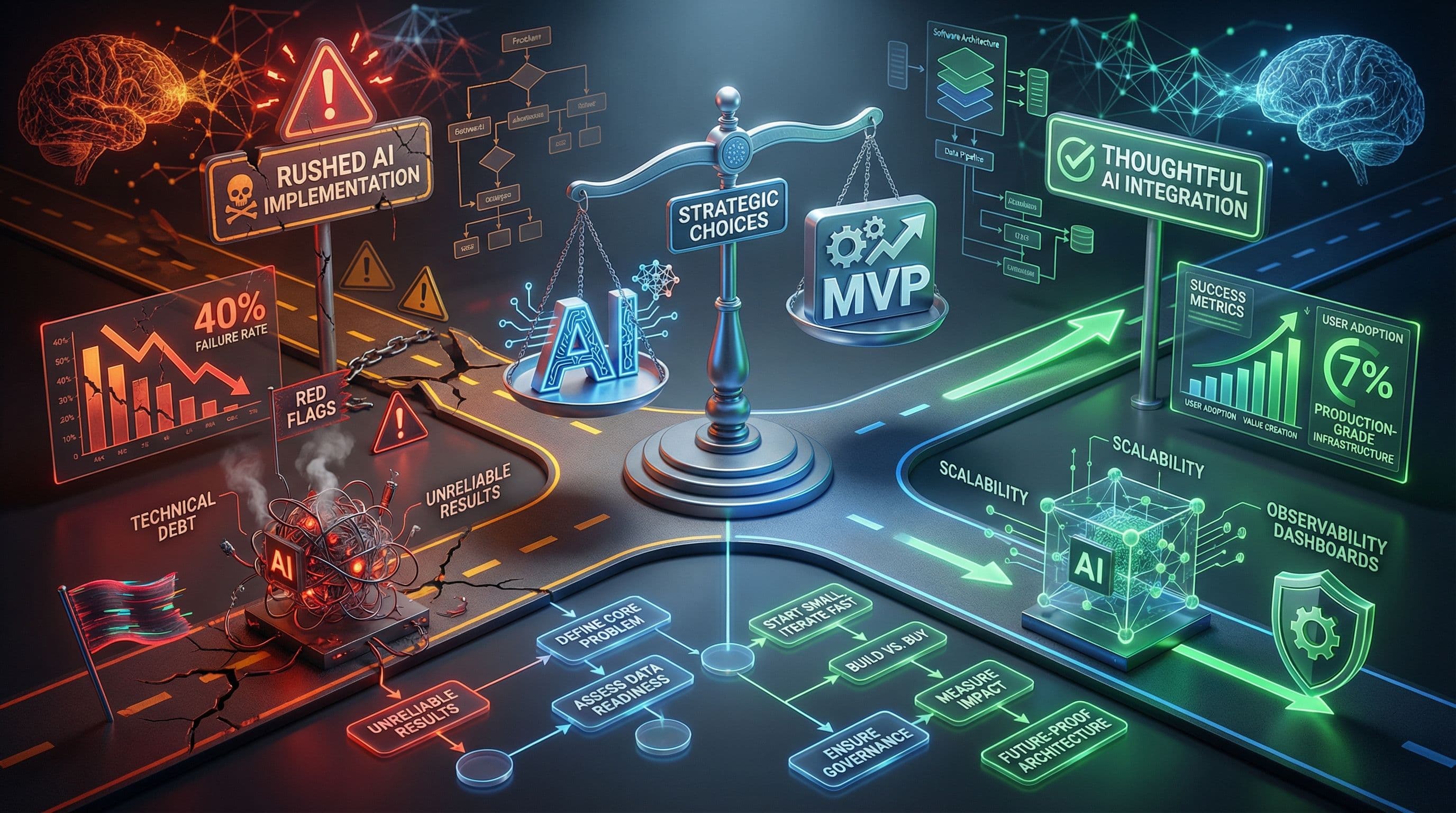
But here's what the data actually shows: 40% of AI MVPs fail not because the technology doesn't work, but because they never integrated into real user workflows. Another 25% fail due to architectural shortcuts that become impossible to fix after launch.
The real question isn't "Can we build this with AI?" It's "Should we?"
The Problem-First Framework
Start with the problem, not the technology.
This sounds obvious. Every founder nods along. Then they immediately start designing around what Claude or GPT-4 can do instead of what their users actually need.
Here's the test: Can you describe your product's core value without mentioning AI? If not, you don't have a product. You have a tech demo.
The companies that survive beyond 18 months treat AI as an internal capability first. They automate internal workflows, prove the value internally, then carefully expose AI to users.
Not the other way around.
When you're prioritizing features for your MVP, AI should pass the same filter as everything else: Does it directly address a user pain point? If it doesn't, leave it out. Even if competitors are shipping AI features.
When AI Actually Belongs in Your MVP
AI makes sense when it underpins your competitive advantage, not when it's a feature checkbox.
Build AI into your MVP when:
- The problem requires it. Your core value proposition breaks without AI. Not "better with AI" but "impossible without AI."
- You have proprietary data. AI trained on your unique dataset creates a moat. AI using public APIs doesn't.
- Deterministic logic fails. The problem genuinely needs probabilistic reasoning, not just complex rules.
- You're automating expert judgment. AI replaces expensive manual work that doesn't scale.
Skip AI in your MVP when:
- You can solve it with rules. Deterministic logic is faster, cheaper, more reliable.
- Users don't trust AI here. High-stakes decisions in regulated industries need human oversight.
- Your dataset is garbage. The dataset is the foundation - it doesn't need to be large, but it must be representative and clean.
- You're just wrapping an API. Calling OpenAI's API isn't a moat. It's a cost center.
The Build vs Buy vs Blend Decision
Most successful AI MVPs use a blend approach: vendor platforms for infrastructure, custom work on prompts and retrieval.
Pure build makes sense when AI is your competitive advantage, involves sensitive regulatory data, or requires deep integration into proprietary systems. But this path costs $150,000 to $500,000+ for enterprise-grade implementations.
Pure buy works when your use case is commoditized or speed-to-value determines success. But you're competing on distribution, not technology.
The blend approach wins for most startups. Use proven vendor platforms for the heavy lifting. Invest engineering time in prompts, retrieval logic, and orchestration that's specific to your domain.
This is similar to how you'd approach deciding between in-house development and outsourcing for other parts of your stack. The question is always where your competitive advantage lives.
The Production-Ready Trap
AI MVPs are expensive to refactor after launch.
Once you integrate data pipelines, embeddings, inference logic, and feedback loops into business workflows, architectural shortcuts become nearly impossible to undo. Common issues that emerge within the first few months:
- Unpredictable behavior. AI works in testing, breaks in production with real user patterns.
- Scaling bottlenecks. What works for 100 users collapses at 1,000 users.
- Runaway costs. Inference costs spike when usage grows.
The temptation is to treat AI like any other MVP component: ship fast, fix later. But AI doesn't work that way.
You need production-grade infrastructure from day one:
- Observability. Log every input, output, and model decision. You'll need this data to debug issues and improve performance.
- Cost controls. Set spending limits, implement caching, monitor per-request costs.
- Fallback behavior. Define what happens when AI fails. Because it will fail.
- Version control. Track prompt changes, model updates, configuration tweaks.
This isn't over-engineering. This is the minimum viable infrastructure for AI in production.
When planning your MVP timeline, add 2-4 weeks specifically for AI observability and controls. Skipping this is how you end up spending months debugging issues you can't reproduce.
The Dataset Reality Check
Your model is only as good as your data.
The dataset doesn't need to be large. It needs to be representative and clean. A focused dataset of 1,000 examples that accurately reflects your use case beats a messy dataset of 100,000 examples scraped from the internet.
Before you commit to AI in your MVP:
- Validate data quality. Is it clean, labeled correctly, representative of real use cases?
- Check coverage. Does it include edge cases, error states, unusual inputs?
- Assess bias. Will it perform equally well across your entire user base?
- Plan collection. How will you improve the dataset after launch?
If you can't answer these questions, you're not ready to ship AI. You're ready to collect more data.
The Cost Structure Nobody Talks About
AI MVP development costs $50,000 to $500,000+ depending on complexity. That's 5-50x more expensive than a traditional software MVP.
Where the money goes:
- Infrastructure. Cloud setup, model serving, vector databases, caching layers.
- Engineering. Prompt engineering, retrieval logic, evaluation frameworks, observability.
- Data. Collection, cleaning, labeling, quality control.
- Iteration. Testing different models, approaches, architectures.
Annual maintenance runs 15-20% of initial development cost. This covers cloud services, API costs, model updates, and monitoring.
For context, a basic AI-enabled feature might add $30,000+ to your MVP budget. An enterprise-grade AI MVP starts at $150,000 minimum.
This matters when you're evaluating the true cost of your MVP. AI isn't just another feature with a linear cost. It's a force multiplier on complexity and budget.
The Internal-First Strategy
The companies that survive beyond 18 months with AI treat it as an internal capability first.
The pattern:
- Start internal. Use AI to automate your own workflows. Customer support, data processing, content generation.
- Prove value. Measure time saved, quality improved, costs reduced.
- Build controls. Observability, cost management, fallback behavior.
- Expose carefully. Once AI works reliably internally, gradually expose it to users.
This approach has multiple benefits. You discover issues with real usage but low stakes. You build operational muscle before facing customer expectations. You validate ROI before committing to user-facing features.
And critically: you avoid the 40% failure rate of AI MVPs that never integrate into real workflows.
If you're adding AI to an existing product, this internal-first approach is even more important. You already have users with expectations. Breaking their workflows with half-baked AI is worse than shipping no AI at all.
The Observability Non-Negotiable
AI without observability is a black box that will eventually explode.
You need to log every input, every output, every model decision. Not for debugging. For understanding what your AI actually does in production.
Minimum observability requirements:
- Request logging. Every input prompt, every output, timestamps, user IDs.
- Cost tracking. Per-request costs, daily spending, budget alerts.
- Performance metrics. Latency, error rates, timeout rates.
- Quality metrics. User feedback, correction rates, escalation to humans.
- Model versioning. Track which prompt version, which model, which configuration.
This data becomes your most valuable asset. It shows you where AI works, where it fails, where it wastes money, where it frustrates users.
Without it, you're flying blind.
When implementing AI agent patterns, observability becomes even more critical. Agents make decisions and take actions without direct supervision. You need complete audit trails.
The Success Metrics That Actually Matter
Don't measure AI success by accuracy. Measure it by business impact.
Define success metrics before building anything:
- User retention. Do users come back? Do they use the AI feature repeatedly?
- Task completion. Do users accomplish their goal faster or better?
- Cost reduction. Does AI reduce operational costs more than it costs to run?
- Revenue impact. Does AI drive conversions, upgrades, or retention?
Accuracy is a technical metric. It doesn't tell you if users find value.
A model with 95% accuracy that frustrates users is worse than an 80% accurate model that solves their problem. Base success metrics on real data, not assumptions.
The RAG vs Fine-Tuning Decision
Most startups should start with RAG (Retrieval Augmented Generation), not fine-tuning.
RAG lets you use existing models with your proprietary data. You build a retrieval system, feed relevant context to the model, and get answers grounded in your data.
RAG works when:
- Your data changes frequently. Product docs, knowledge bases, real-time data.
- You need explainability. You can show exactly which documents informed the answer.
- You have limited ML expertise. RAG is engineering, not ML research.
- Budget is constrained. RAG costs 10-100x less than fine-tuning.
Fine-tuning makes sense when you need the model to learn patterns, not just retrieve facts. But it requires significant ML expertise, large training datasets, and ongoing retraining as data changes.
For startups deciding when they need RAG, start simple. RAG with a good retrieval system beats a poorly fine-tuned model every time.
The Decision Framework
Before shipping AI in your MVP, answer these questions:
Problem validation:
- Can you describe your core value without mentioning AI?
- Does the problem genuinely require probabilistic reasoning?
- Would deterministic logic solve 80% of cases?
Data readiness:
- Is your dataset clean, representative, and labeled?
- Can you collect more data after launch?
- Does your data create a competitive moat?
Infrastructure:
- Can you implement production-grade observability?
- Do you have cost controls and spending limits?
- Have you defined fallback behavior for failures?
Team capability:
- Do you have ML expertise in-house?
- Can you evaluate model performance objectively?
- Can you debug AI-specific issues?
Business case:
- Does AI directly address user pain points?
- Can you measure business impact, not just accuracy?
- Will AI still make sense when competitors copy it?
If you can't confidently answer yes to most of these, AI doesn't belong in your MVP. Build the core product first, prove value, then add AI strategically.
The Bottom Line
40% of AI MVPs fail because founders treat AI as a shortcut instead of an engineering capability. Another 25% fail from architectural shortcuts that become impossible to fix.
The companies that succeed treat AI like any other engineering decision: problem-first, production-ready, measured by business impact.
AI can absolutely belong in your MVP. But only if it underpins competitive advantage, solves a problem that requires it, and launches with production-grade infrastructure.
Everything else is a tech demo waiting to fail.
Ready to build an AI MVP the right way? Let's talk about AI development that actually solves problems instead of chasing trends.