Stripe vs Polar: Merchant of Record for SaaS Founders
Compare Stripe and Polar for SaaS payment processing. Understand the merchant of record model and when it makes sense to let Polar handle your sales tax and compliance.
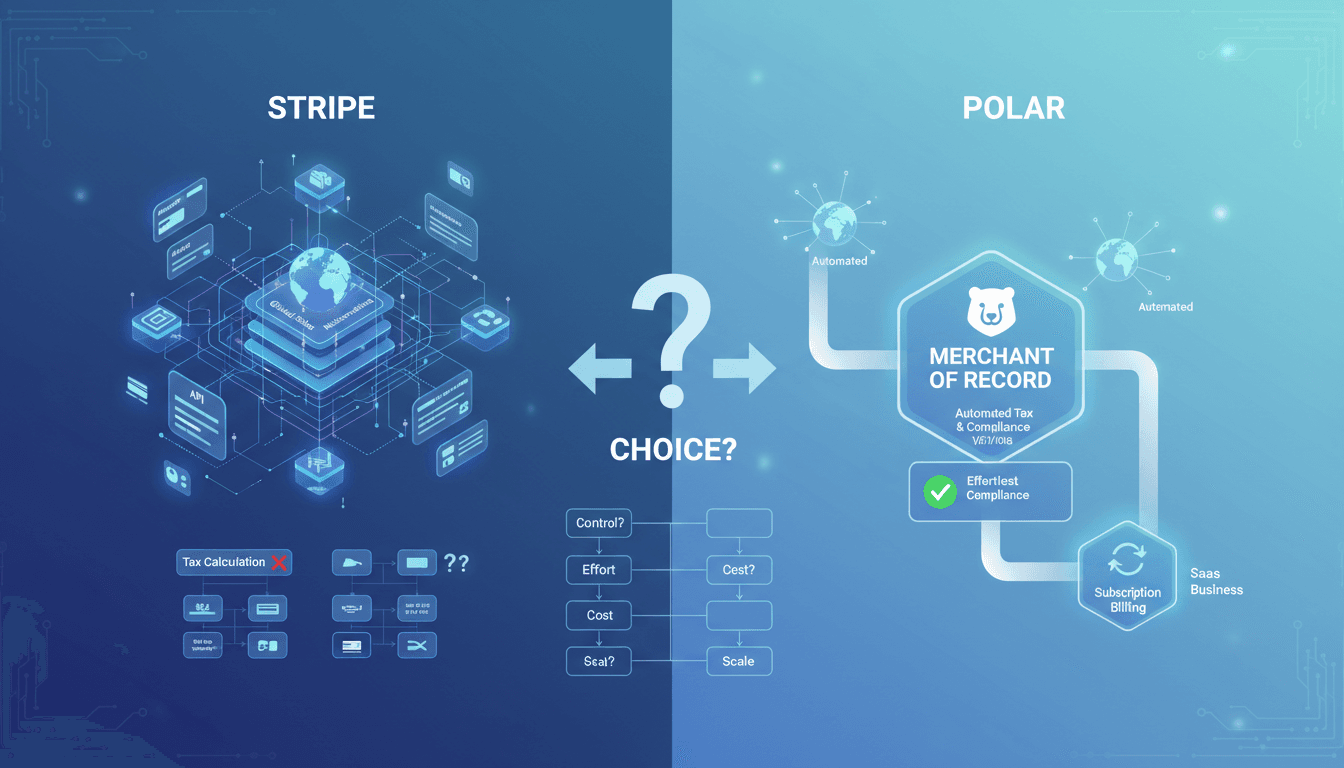
Stripe charges 2.9% + 30 cents per transaction. Polar charges 4% + 40 cents. If you stop the comparison there, Stripe looks like the obvious choice.
It's not that simple. Polar is a Merchant of Record. Stripe is a payment processor. That distinction changes everything about who handles tax compliance, who faces legal liability, and how much work you do to sell globally.
What Merchant of Record Actually Means
A Merchant of Record is the legal entity that sells to your customers. When you use Polar, your customers technically buy from Polar, and Polar pays you. On paper, Polar is the seller.
The MoR handles: sales tax calculation, tax collection, tax remittance, legal liability for compliance, and invoicing requirements per country. With Stripe, you are the Merchant of Record. Stripe moves money. You handle everything else.
The True Cost of Stripe for SaaS
Stripe's base rate of 2.9% + 30 cents is competitive. Add the extras SaaS products need: Stripe Billing (+0.7%), Stripe Tax (+0.5%), International cards (+1.5%). A $99/year subscription from a German customer costs roughly $5.85 (5.9% effective rate). And you still file VAT returns in Germany yourself.
Polar's All-Inclusive Model
Polar charges 4% + 40 cents base, +0.5% for subscriptions, +1.5% for international cards. Same $99 subscription costs roughly $6.35 (6.4% effective rate). Slightly higher per-transaction. But Polar files and remits all taxes. You receive net payouts with zero tax compliance work.
The Hidden Costs of DIY Tax Compliance
The US has 46 states that tax SaaS in some form. Each has different registration requirements and thresholds. Internationally: EU VAT (17-27% rates per country), UK VAT (separate post-Brexit), Canada (up to five registrations), Australia/New Zealand GST.
Stripe's 2022 report found 18% of businesses avoid international expansion specifically because of tax complexity. For a bootstrapped startup, spending 10+ hours/month on tax compliance (or $500-2000/month for a tax service) erases any savings from lower transaction fees.
When Stripe Makes More Sense
- Complex payment architectures (marketplace splits, platform payouts, usage-based billing)
- Dedicated payment infrastructure resources
- Highly customized pricing (per-seat, negotiated enterprise, complex proration)
- US-only for the foreseeable future
- High volume processing ($1M+ annual with volume discounts)
When Polar Makes More Sense
- Early-stage SaaS with global customers
- Solo founders and small teams (time is scarce)
- Simple subscription models ($29/month or $290/year)
- Developer tools and digital products
- Fast launches (6-line integration)
Implementation Recommendation
Phase 1 (Launch to $10K MRR): Use Polar. Get to market fast, validate the business, collect revenue globally without tax headaches.
Phase 2 ($10K-$50K MRR): Evaluate whether Polar's features are limiting you. Plan Stripe migration if you need usage-based or complex enterprise pricing.
Phase 3 ($50K+ MRR): You have resources for dedicated payment infrastructure. Stripe's volume discounts become meaningful.
Final Take
Stripe is the most powerful payment infrastructure available. That power comes with complexity you need to manage. Polar is opinionated: simple pricing, simple integration, compliance handled for you. It trades flexibility for speed and simplicity.
For most SaaS founders at the early stage, speed and simplicity win. Launch on Polar, validate your business, and graduate to Stripe's complexity only when you've earned enough revenue to justify it.
At NextBuild, we implement both Stripe and Polar for clients across fintech, e-commerce, and B2B SaaS.