The Build vs. Buy Decision for Marketing Automation
The martech landscape now has 15,384 commercial solutions. Yet companies still spend $100K+ building custom marketing automation. Here's when each approach actually makes sense for your business.
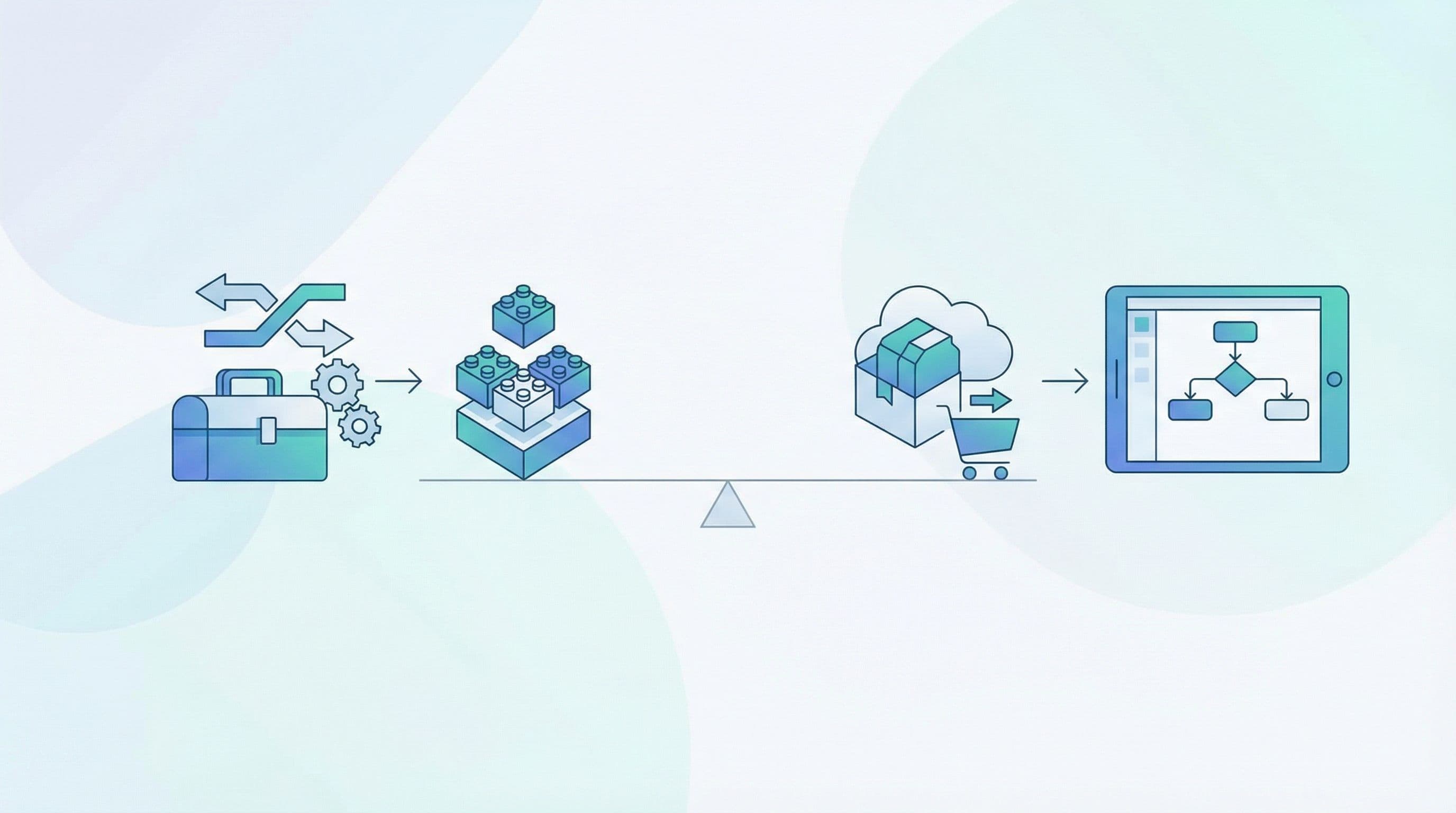
The marketing automation build vs. buy debate has fundamentally changed. What cost $100,000 to build in 2022 is now available as a $99/month subscription. Meanwhile, the enterprise platforms that once justified custom development have become more accessible, while simultaneously creating new limitations that push technical teams back toward building.
This is not a simple buy-unless-you-have-Netflix-money situation. The real answer depends on your integration requirements, your team composition, and where you are in your growth trajectory.
The Real Cost of Buying: Platform Pricing Decoded
Marketing automation platforms have opaque pricing designed to get you in cheap and lock you in as you scale. Here's what you'll actually pay.
Entry-level and SMB tools:
- Klaviyo: $20-35/month at 500 contacts, scaling to $1,200/month at 100K contacts. Their February 2025 switch to active-profile billing caused automatic 25% increases for users exceeding limits.
- Customer.io: $100/month for 5,000 profiles and 1M email sends. Overages hit $0.009 per extra profile. Their startup program offers 12 months free (30K profiles) for companies under $10M raised.
- HubSpot Starter: $9-15/month per seat, but the Professional tier jumps to $890/month plus a $3,000 onboarding fee.
Mid-market and enterprise:
- HubSpot Enterprise: $3,600/month plus a $7,000 onboarding fee. Per-user licensing compounds quickly as marketing expands beyond one team.
- Customer.io Premium: ~$31K/year including HIPAA compliance and 90-day onboarding.
- Iterable: Median buyer cost of $77K/year (based on 188 purchases via Vendr). Entry point around $20K/year for up to 50K MAUs. Implementation alone can run $20K+.
- Braze: $60K-200K/year is typical. Their pricing model explicitly targets enterprise companies, making them a poor fit for startups and small businesses.
The pricing curve matters more than the starting price. A company that grows from 10K to 100K contacts will see their Klaviyo bill increase 10x or more. Planning for year-three costs, not month-one costs, changes the calculus.
The Real Cost of Building: Development Reality Check
Custom marketing automation development runs $50,000-$500,000+ upfront with a 6-12 month timeline. But those headline numbers hide significant complexity.
Team requirements tell the real story. When Lyft built their in-house marketing automation, they needed 7 engineers, 4 data scientists, and 2 embedded marketers for requirements and QA. That's 13 full-time employees before accounting for infrastructure, tooling, or ongoing maintenance.
Specific cost categories:
- AI/ML model training: $22K-$110K+ including infrastructure, software, and implementation
- Quality training datasets: $10K-$90K depending on domain complexity
- Integration development: 25-40% of your total implementation budget
- Ongoing monitoring: $500-$5,000/month for automation systems
- Employee training: $2K-$10K per person on the system
Enterprise data management averages $1.2 million annually at scale. Small and mid-size companies can get by with $5K-$15K annually for proper data infrastructure, but that still adds up.
The honest calculation: if you need to hire even two engineers for a year to build and maintain custom marketing automation, you're looking at $400K+ in fully-loaded costs. That's 5+ years of even expensive SaaS subscriptions.
When Platforms Actually Fail You
Platform limitations are real, but they're often overstated by teams that want to build. Here's what genuinely drives companies toward custom development.
Personalization constraints hit harder than expected. Marketing automation platforms rely on rules-based logic rather than contextual understanding. The personalization feels mechanical because it is mechanical. Platforms struggle to interpret nuanced customer behaviors or adapt to patterns that don't fit predefined segments.
Content standardization creates homogeneity. Templates become repetitive. Every brand on the same platform starts looking similar. The efficiency gains from standardization contradict the need for channel-specific creative approaches.
Analytics stop at surface metrics. Open rates and click-throughs are table stakes. Platforms fail to provide deeper customer journey insights, which restricts your ability to measure true campaign effectiveness or attribute revenue accurately.
Data silos persist despite promises. Marketing automation platforms often struggle to unify customer data from various sources, creating fragmented customer profiles. The single customer view remains more aspiration than reality for most implementations.
Licensing costs compound. As your company grows and marketing automation access expands beyond the core marketing team, per-user licensing becomes a significant portion of personnel expenses. This is the hidden scaling cost that makes the year-three math look very different from month one.
These limitations matter most for companies with complex customer journeys, multiple product lines, or sophisticated attribution requirements. For a company running standard e-commerce email flows, platform limitations rarely justify custom development.
The Integration Calculus
Integration requirements separate companies that should buy from those with legitimate build cases.
Buy when your integrations are common. If your tech stack is Shopify + Klaviyo + Segment + Salesforce, you're operating in well-traveled territory. Pre-built integrations will handle 90%+ of your needs. The remaining 10% can be solved with middleware like Zapier or Make.
Build when you need to connect the unconventional. One reason to build martech is to connect third-party tools with internal systems. Maybe your POS provider doesn't integrate with your feed optimization tool. Maybe you have proprietary data sources that no platform supports. Maybe your compliance requirements demand custom data handling.
A global semiconductor company took the hybrid approach: they built MKTO middleware to bridge Marketo with Google Ads, LinkedIn, Facebook, Forms, eCommerce, CheckMarket, and On24. The result was a 34% increase in nurturing campaign success and 38% improvement in prospect-to-SAL conversion. They bought the core platform and built the connections.
This pattern works for most mid-market companies. The question isn't build OR buy. It's build WHAT and buy WHAT.
The Team You Need (And Probably Don't Have)
Building marketing automation requires cross-functional capabilities that most companies lack.
Minimum viable team:
- Backend engineers who understand event-driven architecture
- Data engineers who can build reliable pipelines
- ML/AI expertise for any personalization or prediction features
- Marketing operations to define requirements and test
- DevOps for infrastructure and monitoring
If you don't have at least three of these five capabilities in-house already, building custom is almost certainly a mistake. You'd be hiring an entire team to build infrastructure rather than allocating engineering bandwidth to product differentiation.
The opportunity cost question: is engineering bandwidth better allocated to building marketing infrastructure or building features that create competitive advantage?
For most companies, the answer is obvious. Marketing automation is not your core product. It's infrastructure that enables your core product. Building AI-native systems from scratch makes sense only when marketing IS your product.
The Hybrid Model That Actually Works
Most companies will do some build and some buy. The strategic question is proportions.
The typical pattern:
- Buy a core platform (Customer.io, Iterable, HubSpot) for email, SMS, and basic orchestration
- Build custom data pipelines to feed the platform
- Build custom analytics and attribution on top of platform data
- Build custom integrations for proprietary systems
This hybrid approach captures the benefits of both: you get the platform's deliverability, compliance, and channel management while maintaining control over your data architecture and custom workflows.
Thomson Reuters implemented automated marketing technology this way and saw 23% more leads sent to sales, 72% faster conversion time, and 175% increase in revenue attributed to marketing. They didn't build from scratch. They extended a platform strategically.
SmartBear Software integrated CRM and marketing automation as a single process, growing lead volume 200% with 85% of revenue coming from automated trial download leads. Again, buying core infrastructure and building integration layers.
When Building Actually Makes Sense
Despite everything above, there are legitimate cases for custom development.
You're operating at true enterprise scale. Netflix built proprietary recommendation and engagement systems because they're processing billions of events across hundreds of millions of users. Their results (35% increase in engagement, 67% boost in retention) justify custom development. But Netflix spent years and hundreds of millions of dollars. As one analyst noted, "Netflix built custom systems that most companies can't afford."
Your industry changes too fast for platforms. If you're in a rapidly evolving vertical where platform features consistently lag behind market requirements, custom development provides flexibility that platforms can't match. This is more common in emerging categories than established ones.
Compliance requirements are genuinely unusual. Some industries have data handling requirements that no standard platform meets. Healthcare with HIPAA, finance with specific state regulations, or government contracting with FedRAMP can all create situations where custom builds are necessary for compliance reasons.
Marketing technology is your product. If you're building a marketing SaaS product yourself, buying a competitor's infrastructure doesn't make sense. You need to own the core technology.
For everyone else, the build case is usually overengineered rationalization. The decision framework for AI features applies here: building custom should be the exceptional choice, not the default.
The Decision Framework
Here's the honest assessment process.
Buy if three or more apply:
- Speed to market matters more than perfect customization
- Your engineering team is under 10 people
- Standard integrations cover 80%+ of your data sources
- You're not sure what your marketing automation should actually do yet
- You need to reduce operational overhead
- Your use case is common (e-commerce, B2B SaaS, subscription business)
Consider building if three or more apply:
- You have 5+ engineers you could dedicate for 6+ months
- Your integration requirements involve proprietary or unusual systems
- You've been on a platform for 2+ years and hit documented, specific limitations
- Your data architecture is already sophisticated and custom
- Compliance requirements eliminate standard platforms
- Marketing automation is directly tied to product differentiation
Warning signs you're overengineering:
- You want to build because the platform feels limiting but can't quantify the cost of those limits
- Your build-vs-buy analysis focuses on technical capability rather than business outcomes
- You're planning to build features that platforms already offer because you want them custom
- The AI component is adding complexity without clear ROI
Making the Math Work
Use an outcome-driven selection process. Define success first, then evaluate options against those outcomes.
For platform evaluation:
- What are the 3-5 campaigns or workflows you need to run in year one?
- What data sources must integrate?
- What's your realistic contact/profile count trajectory?
- What does year-three cost look like, not month-one?
For build consideration:
- What specific capabilities would custom development provide that platforms cannot?
- What's the fully-loaded cost of engineering time over 18 months?
- What's the opportunity cost of allocating engineering to infrastructure vs. product?
- Can you achieve 80% of your custom build goals with platform + middleware?
The cost calculation approach for AI features applies: model realistic usage at scale, not optimistic projections. Include integration maintenance, not just initial development. Account for the engineers you'll need to retain, not just hire.
The Strategic Reality
For over a decade, the build vs. buy conversation centered on legacy martech suites like Salesforce that provided monolithic, all-in-one solutions. Those days are over. The martech landscape now has 15,384 commercial solutions, shifting the balance toward composable architecture and best-of-breed tools connected via APIs.
This shift favors buying. The integration work that once required custom development is increasingly handled by CDP platforms, reverse ETL tools, and specialized middleware. RAG systems for knowledge retrieval exemplify this pattern: what required custom ML engineering two years ago is now available as a managed service.
The companies that still benefit from building are at the extremes: either small enough that a simple solution suffices and any platform is overkill, or large enough that custom development costs become rounding errors on their marketing spend.
Everyone else should buy core infrastructure, build integration layers where needed, and focus engineering resources on what actually differentiates their business.
Building custom marketing automation or evaluating platforms for your martech stack? NextBuild helps technical teams make the build vs. buy decision with realistic cost modeling and implementation support. Talk to us about your marketing infrastructure to get a clear assessment of what to build, what to buy, and how to connect them.